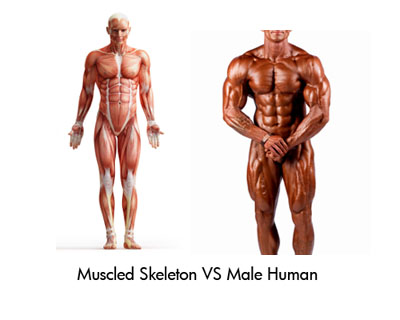
On my old blog, I posted a video on the topic of body fat percentage that is still incredibly popular to this day. However, problems some people had with it were:
a) It is a video, not a blog post
b) It is too long in length
What I want to do with this post is provide a comprehensive picture gallery of various body fat percentages in men and women. In short, I am providing the video in written form with a few changes and updates.
What is the measurement of body fat percentage?
Put simply, measuring body fat percentage is assessing what percentage of your body is made up of fat. The opposing percentages are organs, water, muscle tissue, etc.
What are the methods of measuring body fat percentage?
There are quite a few methods to measure body fat; the most common ones are the following:
1. Skinfold Measurement (Skin Pinch)
2. Bioelectrical Impedance Analysis (Handheld/Scale Device)
3. Dual Energy X-Ray Absorptiometry (DEXA Scan)
4. Height and Circumference Methods (Measurement Collections)
5. Hydrostatic Testing (Underwater Density Test)
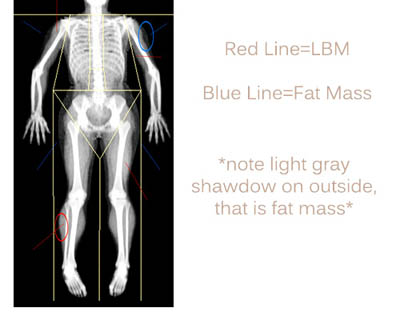
Of all these tests, it is the general consensus that the DEXA scan (Pic 1) provides the most accurate results aside from an autopsy. Knowing the exact body fat percentage while living is extremely difficult. There are many cons to the different types of measurements. Water is usually the leading deceiver of body fat readings in all of the methods.
When we look at the error factors of these methods, we see pictures can be used as much as any of the others.
Do we need to know our body fat percentage?
Technically, there is not a need to know our body fat percentage. While our body fat percentage can provide insights into our health status, simply knowing doesn’t do much to change things. Knowing merely provides amusement, motivation, or a harsh dose of reality.
What is the minimum body fat percentage for human beings and how do we decrease it?
Currently, there is no definitive answer for what is essential body fat. Looking at research though, we assume a range of around 5% for men and 12% for women is essential. For hormonal and reproductive reasons, women need to store a higher level of body fat than men. It is thought that 15% is the lowest range a woman should maintain. There is some argument about this, but technically the data isn’t there to conclude if it is body fat or lifestyle/training habits that cause problems. In my personal opinion, I think women should tread lightly trying to maintain body fat levels below 15%.
To decrease body fat, you need to take part in a deficit based program. If you would like more information on this, please refer to The Fat Loss Troubleshoot.
What do different body fat percentages look like?
As discussed, the level of accuracy regarding body fat levels is difficult to determine even with machine use. Still, there is something to be said for using photography to see varying body fat levels at lower levels of body fat. Is it possible to use pictures to estimate body fat percentages? I think it is as relevant as other basic methods. How can we utilize pictures to determine a rough estimate for body fat pictures? See below.
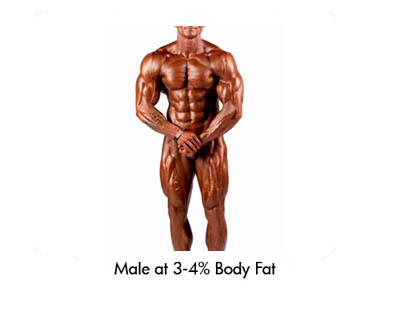
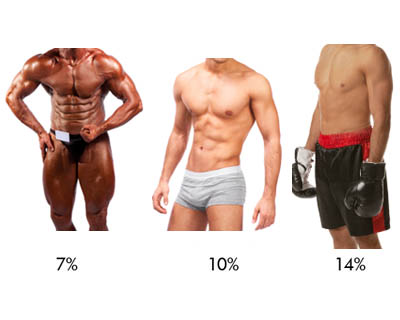
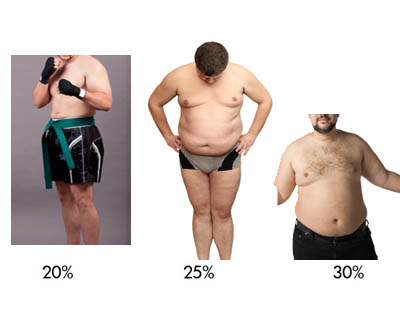
Male Body Fat Percentages by Picture
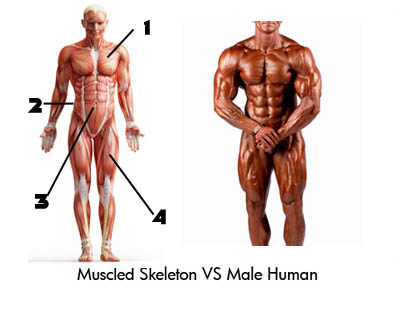
There are various tell-tale signs of body fat levels for men and women. If we look at the lean body mass of a muscled skeleton and compare it to a human counterpart, how low in body fat they are shows. If you consider the skeleton model to be 0% body fat, then simply look at the male model in the picture above and determine how close they are in relation.
Looking at the diagram above for the male, we see clearly defined chest striations (1), serratus anterior (2), upper abdominals (3), and quadriceps (4). For men, generally speaking, these are the last areas that fat is lost. People generally claim much lower body fat percentage than they should. Look at the percentages below and compare them to the muscled skeleton. You will understand why they are at higher body fat levels than you might have thought.
Female Body Fat Percentages by Picture
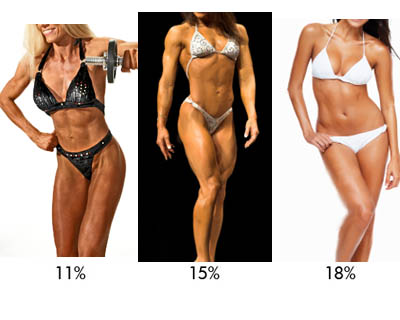
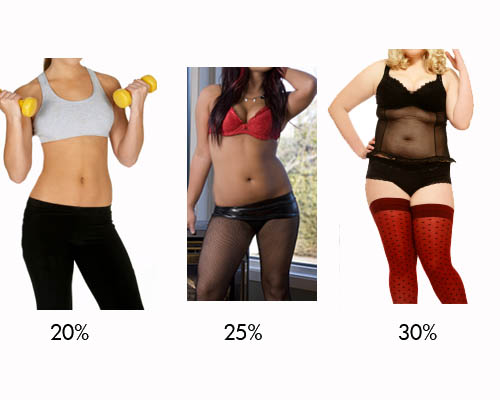
Females follow a lot of the same rules as males with a few slight alterations. Lower body fat levels can really be registered by taking notice of their face (1) chest separation, (2) glutes (not shown), iliacus/quads, (3) and breasts (4).
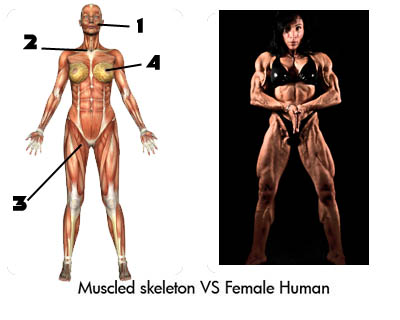
These pictures give you a more accurate look at varying body fat levels and percentages in females.
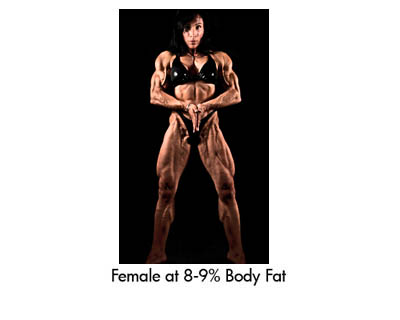
Does everyone look alike at the same body fat percentage?
No, not at all. Body fat percentage isn’t an indicator of your amount of lean body mass. The amount of muscle your body has is going to make a significant difference in your overall look. What is the right look? This is up to personal preference and program design. This post isn’t about judgment, but more so a definition of the difference between the two.
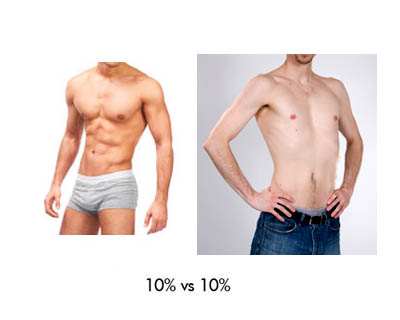
Take these two males in the picture below. Both are roughly at 10% body fat. As you can see, there is a noticeable difference in their look and muscle composition. Again, this isn’t about judging, but simply stating a noticeable physical difference. The guy on the left has a legitimate 15 more pounds of muscle than the guy on the right.
The same is true for these females below. The one on the left is a fitness competitor and the one on the right is a fashion model. You may or may not like one or the other’s appearance, but that isn’t the point of the comparison. The point is that both have roughly 15% body fat with varying levels of water depletion. As you can see, there is quite a stark difference between the two.
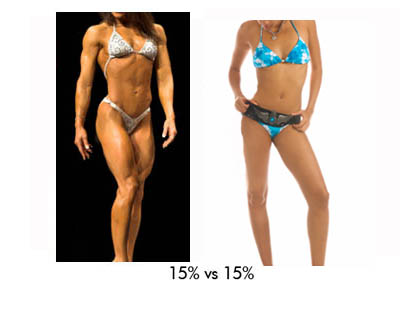
There are also other variables and factors to take into consideration when looking at body composition. One of the main factors is carbohydrate and water manipulation. I discuss in detail how to manipulate both in the Water Manual. Water manipulation or advanced super-compensation techniques can have dramatic differences on your appearance. The 15% woman on the left is likely utilizing those techniques. It is often done by bodybuilders and figure competitors.
Would You Like A Body Fat Percentage Assessment?
As you can see body fat percentages range and methods for measurement vary. You can also see training will greatly affect what you look like at various body fat percentages. Any questions? If you want to know what I think your body fat percentage is, contact me to become a client.
257 comments
Benjamin Teal
February 21, 2010 at 11:57 pmLeigh, as usual, great post. I do like the post format vs. the video format.
I like it in that it gives folks a good visual reference for estimating body fat percentage without going through the process of calipers or underwater weighing (or even using a calculator). Look in the mirror, look at the picture, which one is a close match, estimate, move on. Focus on taking action to move to the next picture down.
Keep fighting the good fight.
Ben
Leigh Peele
February 22, 2010 at 6:46 pmThanks and good point of view.
Taylor
January 11, 2012 at 5:21 pmAwesome article, i used this and cited you on my website. Haven’t come across to many articles with such great before/after photos
http://taylorcarpenter-pt.com/body-fat-vs-the-scale
marco
July 27, 2012 at 1:35 pmI very much enjoyed the addition of explaining the difference between 10% of skinny and 10% of a conditioned body. There is a BIG difference. I also further enjoyed how your article stayed on topic. It did not delve into the superiority of one athletic event over another. What I did not see a mention of, is some indication of work needed to reach these levels. The amounts of bodyfat also involve genetics to a point. Some are gifted in this area, some will have to work at it, while others will see improvements but never reach that level. Thank you for the education and enlightenment.
emily
November 26, 2014 at 2:29 amEXCUSE ME, but I have a problem with the picture of these women… how come you have put the obese women dressed like hookers?? while the fit women get to wear nice bikini’s and the middle sized women get to wear active clothing???? THIS IS WRONG! All the women should be wearing the same outfit to properly convey an accurate comparison. There is something completely absurd and disturbing about this. As a yoga instructor I come across many different shapes and sizes and more often then not these are not the women prancing around in booty shorts and crop tops.
brandon lewis
March 24, 2015 at 5:06 pmEXCUSE ME, please shut the fuck up… you are ridiculous….
Hector
October 30, 2015 at 10:55 pmI don’t think it is ridiculous, I think the lady has a point, a set of pictures like this tend suggest a diminishing value of women with more than 20% Fat.
A make you fell bad kind of thing if you know what I mean…
Faris
December 4, 2015 at 12:37 pmHow come men get to wear no bras and women do? Why are the women wearing a bra unlike men?
Ali
January 13, 2016 at 10:10 amWhile I will agree that the leather looking underwear and the red thigh high nylons do look ridiculous, I also don’t think you are understanding the whole point of this article, which is titled, “Body Fat Pictures and Percentages.”
Obviously it would be ideal to have the people all in the same outfit. However, that would take time and money and I am assuming this article is for a blog, not for a book.
You say that women in your yoga practice of different shapes and sizes do not prance around in booty shorts and crop tops. Of course most women want to dress themselves attractively and in clothing that highlights their attributes and diminishes whatever they perceive their flaws to be.
Obviously the author of this article was not going to pick a photo of a women covering up her body to illustrate the concept of body fat percentage.
I am assuming that on an everyday basis the photos of the women at 11% and 15% aren’t representing outfits and women at this weight would usually wear. However, they do represent women at that range of body fat.
I was trying to determine a goal bodyfat, so this article and the photos are very much appreciated. I am at 29% bodyfat. I was not offended by the 30% bodyfat photo. From this article and a few others I have read, I am able to determine my goal bodyfat is 18%.
Oh – and a side note for Emily…”there is something completely absurd and disturbing” about calling any of the women in these photos obese.
Denise poplawski
January 26, 2016 at 3:51 amYou have a great point and I agree with you.
Violet
August 24, 2016 at 11:49 pmYou have a valid point.
Jen
November 11, 2016 at 8:41 pmI kind of have a problem with you saying they are dressed as hooked simply because they choose to dress sexy. I say everyone (including the men) should wear lingerie.
Eddie
January 11, 2017 at 8:21 pmLol. Sure, Emily.
And while we’re at making the pictures equal, we may as well get rid of those role-oppressive bikini tops, since the men are bare-chested. I demand that the women are topless too. For accurate comparison…
Eric Graden
February 22, 2010 at 12:39 amThis is bookmarked and will be used as a reference to so so so many people who have no idea body fat percentege means. Excellent post Leigh, thank you.
Leigh Peele
February 22, 2010 at 6:47 pmAppreciated Eric.
JenBD
February 22, 2010 at 1:14 amWow, very cool post! I have been looking for something just like this. Now can we submit our own?
Leigh Peele
February 22, 2010 at 6:50 pmLike I said, you are more than welcome to submit in the forums. I don’t know how much time I have to do it right now to people sending them in but perhaps I could work out a follow-up post.
Becc
February 22, 2010 at 1:20 amThanks Leigh, as always very informative. You hear people talk about % all the time but it makes heaps more sense when you have visual aids.
Leigh Peele
February 22, 2010 at 6:50 pmWelcome.
shanice fling
October 31, 2011 at 2:55 pmwooowooowoowoowoowo
Rhys I
February 22, 2010 at 6:42 amWhat-Up Leigh!
I’ve recently had a sharp wake up call. Whilst on my undergrad using hydrostatic weighing and skinfold i measured around 23%, not great but passable for my goals.
Then a few weeks ago on my postgrad we did skinfold again 19%, the tester was reasonably inexperienced so i took it with a pinch of salt but bioelectirical impedance measured me as 24%. Again i can live with this for now because i’ve been training for a weightlifting comp so body comp has not been my goal.
But then we used a DEXA scan. It came out as 36%!!! I weigh 235lbs at 5ft 9inches so thats a good amount of fat on me according to this. Looking at the photos and being very honest with myself i would say i’m between the guy with 20 and 25% BF. I know DEXA is meant to be a reliable test, what do you think about it all? Has been a major blow for me, i don’t mind sitting around 20% But 36% is awful!!!
Leigh Peele
February 22, 2010 at 7:14 pmWell this strongly depends on your training level so let’s look at it like this.
At 5’9 it is typical that the average trainee (a few years of training under their belt, hasn’t been massively sedentary their entire life) to see their abs around 150-155lbs. Like I said this varies depending on trainees but from what I have seen, this is a good base compass. If that is roughly in the area of 9-12% depending on LBM for men…start to do the math of where you are at. Means roughly 70lbs of fat loss till your could get to that point.
This formula comes from Tom Venuto
Example:
You are male
Your weight: 235
Your body fat: 36%
Your fat weight: 84lbs (36% of 235 lbs)
Your lean mass: 151 lbs. (total weight – lbs. of fat)
Your target body fat percentage: 12% (.12)
Determine your percentage of lean mass at your target body fat by subtracting your
desired body fat from 1: (1 -.12 = .88)
Divide your current lean mass by your percentage of lean mass at your target body fat
percentage to yield your ideal weight: (151/.88 = 171
Thus, your ideal weight at 12% body fat is 171 lbs.”
So I stated roughly 70lbs of fat lost to get to a point of possible Abs show. This Formula states based off of the Dexa roughly 64lbs lost to get to 12% body fat.
I say 70lbs is what you are looking at, from there adjust depending on goals (if abdominal showing is even a goal.).
Rhys I
February 22, 2010 at 7:44 pmThanks for that Leigh, interesting stuff. I’ve been training for about 7/8 yrs now and compete in olympic weightlifting so my training age is good. My target has always been strength and performance in rugby, but now i don’t play rugby and just concentrate on the lifting i’m considering giving dieting seriously and focussing on fat loss a go for the first time. Its never been a goal of mine (i think partly because my body type makes it easier to get big and strong than lose weight) but i fancy a change!
Thanks again
MATT
June 7, 2016 at 9:06 amThis was fantastic thanks
Missy
February 22, 2010 at 8:50 amThanks, great to have the “condensed” version (but I do like the video!) to refer to!
You rock as always!!
Leigh Peele
February 22, 2010 at 7:15 pmThank ya missy
Erica
February 22, 2010 at 9:46 amLeigh, were the people pictured in this blog post measured via DEXA scan?
Leigh Peele
February 22, 2010 at 7:17 pmNo, the purpose of this post is the discussion and use of body fat estimations by pictures. IN no way is it saying it is a definitive number but it is an educated guess based on the things I demonstrated. Like I said “Of all these tests, it is a general consensus the DEXA scan (pic 1) provides the most accurate results you can achieve beyond doing an autopsy. Knowing the exact body fat percentage while living is very difficult.”
Erica
February 23, 2010 at 9:44 amThanks for clarifying, Leigh. I was wondering because I am 27% body fat according to the BodPod (supposedly very accurate?) and I look far leaner than the 25% picture: I’m a competitive athlete (in a sport with weight classes), no love handles or muffin top, about a size 4 with visible abs and delts. However, according to calipers I am far leaner (less than 17% body fat), so perhaps that is the metric you are using?
Gráinne
February 24, 2010 at 5:59 amI’m not an expert…but looked into BodPod before. Apparently it can be made inaccurate easily enough by clothing etc-if your swimsuit isn’t completely skintight or if the cap doesn’t squeeze all the air out of your hair and get it completely flat it can overread because it’s being based on air displacement.
I tend to trust calipers if they’re being done by somebody experienced. I got one of my friends (an exercise physiologist who does fitness assessments all the time) to test me 2 weeks after I had a Dexa. Didn’t tell him result when he was testing. He was within 1%!
Erica
February 25, 2010 at 9:13 amI was wearing special compression garments + swim cap.
Amy
February 22, 2010 at 10:40 amThanks! I do like this format better than the videos, and will be using the article to help me reach and assess my short-term BF goal of 20%…Great job, as always!
Leigh Peele
February 22, 2010 at 7:18 pmWelcome Amy.
Ginger
February 22, 2010 at 12:51 pmThanks Leigh! This makes it easier to ne clear about what my goals and starting point are. It seems that the way someone looks is an intersection between how much muscle mass one has and body fat percentage. I wish that we could develop some common language to describe how much muscle one is carrying like 0 = little to no muscle bulk like the skinny guy/girl in the comparison pictures, 10 is a hyooge body builder, etc. Then we could put bf% on the x axis and muscle bulk on the y and plot the pictures…. Okay I’m getting a little dorky.
Leigh Peele
February 22, 2010 at 7:19 pmActually I am working on a terminology and formula for these things to help for the Make My body Release.
Erikk
February 22, 2010 at 1:02 pmThere is no w3ay you can be correct with this estimations, they are way to high. I got my body fat measured by a professional trainer and it said 10% and I don’t have ab definition yet.
Leigh Peele
February 22, 2010 at 7:21 pmErik I have to agree with CanneW and also state this professional trainers can be very wrong about body fat estimations. I know in the beginning I certainly was with my skinfold usage.
Karen
February 22, 2010 at 2:59 pmGreat post!
Liv
February 22, 2010 at 3:24 pmWhat took you so long 😉
Is it possible for you to do more than just this one? Perhaps a range of male and female from 4% up / 8% up?
Leigh Peele
February 22, 2010 at 7:22 pmInteresting idea, I will see what I can do. It can be tough finding the pictures I need.
andy
December 2, 2010 at 10:52 amif you are looking for more pictures, try the body space profiles on bodybuilding.com they have tons of people posting their pictures at all different stages of muscle gain and fat loss.
Kri-dgo
February 22, 2010 at 3:57 pmI am sorry but I look way better at my measured 29% than the girl does at 20%. This seems very biased against making women feel fatter. We can’t all be lingere model’s.
Cindy Beverly
February 22, 2010 at 5:33 pmIf you had listened to Leigh’s recent podcast and some of her previous ones, you’d realize that she is not making value judgments based on bf %. If you are happy in your skin, then you have arrived. Those of us who aspire to different goals but have not reached them are still on the journey. Personally, I don’t like how I look at 29%, my facial features become obscured and I get back fat. Closer to 20%, My lips look fuller, my nose looks smaller, my cheekbones are nicely defined, and I don’t have any bra bulges on my back. That’s how I like to look. Better for me, but not a requirement for anyone else.
Leigh Peele
February 22, 2010 at 7:24 pmBeyond the great input Cindy has, I also stated that different people look different at different body fat percentages. If you took two female twins and both were at 22% but one had 8 more pounds of LBM they would look very different and the one with more LBM with more than likely appear to be more “toned” and defined at a higher body fat.
kate
February 26, 2010 at 4:53 pmWhy would the person with higher LBM appear more ‘toned’ at the same fat percentage? Wouldn’t they have more fat as well and just be bigger but with the same level of definition. When I look at the girl at 25% body for example, she looks thin but sort of flabby. She may well be closer to 30% body fat with low LBM.
When I look at the comparison of the two women supposedly both at 15%, the one on the left looks somewhere between your example of 11% and 15% body fat, but the one on the right looks between the 18% and 20% body fat pics.
Leigh Peele
February 26, 2010 at 5:22 pmThink of your skin as a bed sheet. If you lay a bed sheet on bed with a couple of peas you will barely notice a difference or the peas presence. If you lay the bed sheet over mounds of potatoes you will see a noticeable change in mass shape. The sheet did not get thinner or change in its size, nor did the mattress it rests on. The potatoes (muscle) is the only thing that changed, there for providing different definition on the same surface.
The 15% woman is not the same at all. She is soft in her legs and doesn’t have noticeable chest separation even flexing. There are various other reasons as well. These are small difference, but differences they are.
kate
February 26, 2010 at 5:49 pmI’m still a bit confused, if two women are at the same fat percentage but one has more LBM won’t they also have proportionately more fat on them..so the sheet thickness doesn’t change, but won’t the mattress (fat layer) be slightly thicker?
Example, woman at 120lb and 20% body fat has 24lb of fat plus 96lb of LBM. Woman at 130lb and 20% body fat has 26lb of fat and 104lb of lean mass. I realise most of the weight difference is due to the increase in muscle mass, but even just 2lb of extra fat should maintain the same level of definition right?
Sorry if I sound whiney and nitpicky lol, but just curious and would like to understand better.
I. G.
June 3, 2012 at 11:31 amI would love if Kate´s question from February 26, 2010 would be answered because it is very relevant. It doesn´t convince me as well that 15% body fat makes one woman look ripped just because she weights more and thus has more muscle mass and another one totally different just because whe weights less. Body fat percentage is a RELATIVE number which means she necessarily has more fat as well to reach the same PERCENTAGE if she is at a heigher weight. It means that the matress above the peas/potatoes (Leigh Peele´s example) is just as thick in relation to her muscle mass. If the fat layer was thinner she was at a lower body fat PERCENTAGE!
Veronica
September 22, 2013 at 7:34 pmConsidering the numbers you gave, and assuming they have the same lean mass, yes the 130lbs female has 2lbs more fat, but she also has 8lbs more muscle. When you add 4x as muscle than you add fat, it more than makes up for the size difference between a pound of muscle vs a pound of fat.
But what gets confusing is when you take into account height. The taller person will have more lean mass, less muscle, and the same amount of fat as someone with the same body fat percentage and weight at a shorter height. And they will look different. Heck, throw in bone structure, and people the same height will look different at the same bf%.
So it is best to consider the same person, not different people when making comparisons because there are way too many variables.
cannew
February 22, 2010 at 5:47 pmerikk – no offense… but if you don’t have any abs at 10% then either 1. you are really higher than 10% body fat or 2. you need to train your abs harder to show the muscle definition (like the skinny guy in the pix above).
Tony Difilipo
February 22, 2010 at 10:14 pmLeigh,
Quick question…..with regards to the pictures of the male at around 3-4 percent and the female at around 8-9 percent, do those numbers include the roughly 3 percent (at least I think that is about accurate) essential fat that is part of the make-up of the CNS?
On a side note, given your comment about photos as a potentially valid method of tracking progress (along with other metrics and methods of tracking that you can use along with it), would you say that the product in the following link is likely overrated and very over-priced fro someone training clients (a mix of general population, sporting athletes, and physique competitors?
http://intelametrix.com/Technology/Index.htm
http://www.staleytraining.com/articles/product-reviews/bodymetrix-review.htm
Note: I linked to Coach Staley’s website review not to create any sort of friction, but merely because the review posted a price range for the item, which was not listed directly on the Intelametrix website.
Leigh Peele
February 24, 2010 at 7:54 pmWhat I am speaking of is levels of subcutaneous fat.
As for the device, there is absolutely no need for something like that. Why? What purpose would something like that serve other than novelty ya know? My clients get way more impressed when I use their own photos and numbers to help deliver a more than accurate enough number for tracking and goals.
I think if you have to rely on something like that, you are reaching for results instead of seeing them.
Kyle
February 23, 2010 at 12:57 pmhaha I look exactly like the scrawny 10%-er. Time to keep working on bulking up!
MV
February 23, 2010 at 2:09 pmHey Leigh,
love your posts and podcasts and the fitcast! I’m curious, I think I may actually be estimating my body fat percentage too high! I thought I was around 22-24% but I look way more like that 18%-20%. Is it possible for you to post a few more photos in that range of more muscular women? the women in the 18 and 20 look still pretty low-muscle to me. Thanks so much for all your work! You’ve definitely given me a new unemotional outlook on fat loss.
Leigh Peele
February 24, 2010 at 7:56 pmAfter putting up this post I have received more request of varying body fat/lbm levels. It should (hopefully) be up within the next two weeks.
MV
February 27, 2010 at 1:19 amLet us know if you need more photos! 🙂
Covermea
February 23, 2010 at 3:02 pmI love this post Leigh. I actually enjoyed the video too, I am surprise that you compacted all that information into this article.
Laura
February 23, 2010 at 5:32 pmThat was a most interesting post. I really liked seeing the visual difference between bodies and corresponding it with the numbers.
I like the 18% female – I’m making that my goal once I get off the Synthyroid and onto the dessicated thyroid. I think that will make a difference along with your plan.
Thanks Leigh. You Rock..
Daniel
February 24, 2010 at 9:34 amLeigh,
I would love a gallery of picture with various amounts of body fat and muscle mass. I greatly appreciate what you have done here giving visual examples, but as the 10 % pics of skinny guy and track guy show there is alot of variance.
Thanks for all you do
Ginger Hodge
February 24, 2010 at 1:40 pmLeigh, I went back and read your realistic goal setting posts- I found a place that suggests how fast one can gain muscle, but not how fast one could expect to lose fat. Is this somewhere, and if not could you give some recommendations on timeframe when setting fat loss goals, either by pounds or percentages? I would also like to know possible side effects on the body when comparing a slow and steady or rapid fat loss route. Thanks for all of your great info! You have finally brought me around to the reality of energy balance and I’
ready to get something done! Thanks.
Laura
February 24, 2010 at 5:51 pmHi Leigh…another great post! Thank you! I just read your TroubleShoot in 1 day…loved it. But I was left wondering can I safely have a large deficit if re-feeding days are incorporated every week? I have trouble eating enough to keep my deficit below 1000 daily, and exercising less just seems counter intuitive. I recently came across this statement on a random website, which i’m sure is not the most reliable resource, but I thought that it could potentially make some sense!
“It has been found in scientific work that a sedentary person can oxidize 31 calories from adipose tissue every 24 hours. This means that the more fat you carry, the larger your deficit can be, without catabolized non-fatty tissues (muscle).”
If this were true, then at 5′-6″ and 205lbs, having about 80 lbs of fat to lose, my deficit could safely be 2480??!! Now I know THAT doesn’t make sense, but would you say that the more body fat you have to lose, the greater your deficit can be daily without eating away prescious lean tissue?? I generally have a fairly high deficit (between 1600-1000) during the week, with a surplus/maintenance on weekends, and I am having big time trouble losing anything, so i’m assuming the answer is my deficit is too high. The OPT program sounds great, but i’m not sure such a structured program will last long with me. Any advice would be greatly appreciated…thank you!!
summerset
February 26, 2010 at 11:09 amLaura, your problem could also lie in overestimating your maintenance and therefore overeating on the weekends which would cancel out the deficit you created during the week. Instead of the entire weekend on higher caloric intake, try one day at maintenance. Look at the overall picture and not just the day to day. You have to have the 3500 calorie deficit from somewhere to get the fat off, but you can easily put that back on with one big splurge day. One pound down, 2 lbs up, repeat. That is more of a maintenance plan and not a fat loss plan. And yes, the more fat you have to lose the bigger your deficit can be.
Laura
February 26, 2010 at 3:10 pmThanks for that Summerset…I will be more careful on weekends..perhaps i’m underestimating my calories there! Do you know if there is a formula or some way of estimating a safe daily caloric deficit depending on how much fat you have to lose? Thanks so much!
Leigh Peele
February 27, 2010 at 2:32 amThere is no such thing as a “safe’ caloric deficit amount. It varies on protein intake, length of time, training, goals, health, etc. To put it simply each person has a different “breaking” point and what that point is. If you don’t know how to maximize that or don’t read the literature to know how to do so, going with the standard tried and true methods are often best.
That being said these topics are discussed a lot on the blog and in podcasts, as well as in the books.
Carrie Gray
February 25, 2010 at 11:47 amLoved this post, thanks so much! I never saw the video, but having these pictures is going to be a huge help in determining what I want my end goals to be.
Leigh Peele
February 27, 2010 at 2:33 amThanks Carrie
Brooke
February 25, 2010 at 4:43 pmThank god I am not the only one who agrees that these are extremly wrong estimates. I think I will trust the NY times over some no name with a blog who thinks they no it all. Get a life and a better job. I have been training for years and your estimates tell me I am overweight, I don’t think so.
Leigh Peele
February 27, 2010 at 2:33 amBrooke, I don’t know who you are calling a no-name, but they love me in sweden.
Chris
April 8, 2010 at 12:05 pmThat’s a smart decision on your part Brooke since we all “know” (please notice the correct spelling of such a tricky word) that there is no deception or misleading information to be found in the media. Kudos to you!
Amy
February 25, 2010 at 9:30 pmThe bigger question is why would you, Brooke, take the time to respond to a no-name blog? Who asked for your opinion? Who is forcing you to read this blog? Personally, I find the info helpful, and presented in a way that makes sense.
And, remember: At the end of the day, it depends.
Leigh Peele
February 27, 2010 at 2:34 amBooyah
April
February 26, 2010 at 8:38 amYou are so good at explaining things. Keep it coming!
Leigh Peele
February 27, 2010 at 2:35 amThanks April.
Doug
February 26, 2010 at 9:29 amWhat about the body types(endo, meso, and ectomorph)? You differentiate
between people of the same body fat percentage with a visual difference by saying one has
more or less muscle. While this is true how we will look with different levels of fat depends
on our genetically determined body type also. I think it would be interesting to see
the different body types at high and low fat levels.
Leigh Peele
February 26, 2010 at 4:10 pmSomatotyping, while an interesting theory for topic of conversation, doesn’t play into factors or how you carry body fat as much as how you manage and partition. Sure, you could make an argument that the 10% athlete is a Meso and the tall skinny guy is an Ecto, but that comes into play if you are discussing potential dieting strategies. Somatotyping, to me, is as much psychological and environmental as it is stamped in genetics. My longwinded point is I would much rather discuss Somatotyping on its own than just in relation to this post.
Gayle
February 26, 2010 at 10:05 amit was so timely for me to read your article. I am a female who has been overweight most of my life until the last 4 to 5 years. I have lost 45 lbs. Through discovering exercise and FINALLY eating right. Thing is I lift weghts 3-4 days week regularly and do Cardio daily . I am 57 and weigh 125 Eat 5 to 6 small meals a day with good raitos YADA YADA I exercise at least 2 hrs a day Hard.{ I do Chalene Extreme and INSANITY Daily} YET I know you do not mention body fat scales[I have 2 different ones one at summer house} but mine NEVER gives me a reading below 30%. I look like your picture of the 20% or belowpicture WHATS up with that?
Leigh Peele
February 26, 2010 at 4:12 pmBody Fat Scales depend a lot of water fluctuations because of how they measure electro movements. It seems to me you are likely leading to the side of overtraining as well, which could cause increase in inflammation. Inflammation=more water=less accurate reading than you already get.
Krista
February 26, 2010 at 12:24 pmThanks for this, Leigh….
kate
February 26, 2010 at 4:58 pmDEXA measured me at 24% body fat and I look closest to the 20% body fat example (female). Maybe some of the differences lie in fat distsribution patterns plus how much fat is subcutaneous versus internal or intramuscular.
Clara
February 26, 2010 at 6:21 pmExcellent! This is a great guide that I can shoot clients over to help get some better understanding of what body comp means. Best shots are the ones showing how one person at a given bf% doesn’t automatically mean another person at the same percentage matches.
Thanks!
Lindsey Mathews
February 26, 2010 at 9:09 pmBrooke – HA HA HA, wow. All I can say. Leigh – Thanks for the great post. It is actually helping me clear up some confusion going in my head about my goals and where I want to be. I think I might just be where I want to be! Isn’t THAT a great revelation?! 🙂
Leigh Peele
February 27, 2010 at 2:36 amNever a bad thing to figure that out eh? Congrats, not it’s all about paying it forward 😉
Krispy1138
February 26, 2010 at 9:52 pmThis was one of your best, Leigh!
Leigh Peele
February 27, 2010 at 2:36 amThanks Krispy!
Brooke
February 26, 2010 at 10:31 pmExcuse me, you people obviously think you are cooler than you are but I am a certified trainer and graduate in health and fitness studies. I think I know more about this than you given it is MY JOB. You should leave these things to professional like trainers and dietitians. Trainers aren’t allowed to use equipment like DEXA scans by the way, this person seems like a con artist. I get stead readings on calipers showing 18% body fat.
Leigh Peele
February 27, 2010 at 2:37 amMy blog is cooler than your blog.
Lindsey Mathews
February 26, 2010 at 10:40 pmHoney, it’s all of our jobs. You can’t know too much about the big names in the field if you think Leigh Peele is a no name. Just saying.
Haphazard Thoughts 03-03-2010 | Leigh Peele
March 3, 2010 at 4:09 am[…] have received a tremendous response from the Body Fat Picture article on wanting more examples. You would be surprised how hard it is to come by people […]
Richie
March 3, 2010 at 9:55 amGreat visual post Leigh!!
I am a certified trainer too, we all have opinions and they may differ a little, but, we are all trying to help the masses achieve their health and weight loss goals, there is no need to be rude Brooke, I will happily look at your blog or website and criticize if you have one???
Flux Capacitor Friday (3/4/10) : KevinLarrabee.com
March 5, 2010 at 8:04 am[…] (Since Leigh and I are sleeping together I guess I should give her a plug as well. Her recent post on body fat was pretty bad ass. Check it […]
Mickey
March 5, 2010 at 12:59 pmLeigh, Once again…good work…
Brooke, as Richie mentioned we would all love to read your blog and/or website. Or perhaps any articles that have been published in respectable journals or fitness magazines. But unlike you, Leigh probablly won’t resort to calling you a ‘no-name’…I’m sure based off of your highly intelligent posts that contain great supportive data that you will be a household name soon enough! But if I’m incorrect in that assumption, please forgive me…you can always find your name referenced in a book of baby names.
I never do crunches « Fitness Overload
March 10, 2010 at 9:56 am[…] get some good habits the fat should start to melt off. Once it does get down to a certain level (around 10-12% for a guy and 18% for a girl) any muscle tone in the ab structure will start to show through. As you approach these numbers you […]
R*S
March 28, 2010 at 4:51 amJust curious on your thoughts of the Navy formula? It seems to be fairly accurate (claims validated by MRI are suppose to be R2: .89, SEE: 3.1%) though not very precises. Not close enough for most 1 week changes, but is dead simple to do. I would guess it is better than calipers for most newbies, and way better than impedance scales.
%fat=495/(1.0324-.19077(log(abdomen-neck)) + .15456(log(height)))-450 (men)
%fat = 495/(1.29579-.35004(log(abd+hip-neck))+.22100(log(height)))-450 (women)
January cutting - Page 10 - Myprotein Forum
March 31, 2010 at 6:06 am[…] Originally Posted by CosmicFish Quick update: I finished my diet today (just after the caliper test was done ). For three months work I've dropped 20lbs of weight, ~15lbs of which seems to be fat. BF% came in at just under 9% – down from just over 16%. The only negative is I still don't have visible abs, althought the beginnings of some definition is visible in the right lighting and I can feel the separation between the abs with my fingers. Overall I'm pleased though. Plan for April is to slowly ramp up the calories to previous maintenance levels for an attempt at a lowish carb lean bulk from May onwards. If I can keep from putting on too much fat I might be in a better position to get leaner with a cut in the mid/late summer. Has anybody else persisted with theirs for this long? I'm curious to hear about other people's results if so. Correct me if I'm wrong but shouldn't abs be visible at 9% bodyfat? Have a look at this: Body Fat Pictures and Percentages | Leigh Peele […]
“I want to lose 15 pounds” « Fitness Overload
April 2, 2010 at 8:59 am[…] you still aren’t sure this article shows what body fat percentages look like on real […]
do you read leigh peele? | How I Lost 20lbs
April 5, 2010 at 1:15 pm[…] first useful tool I want to introduce is her post on Body Fat Pictures and Percentages. If you have not seen this page before, go now and take a […]
Peter Schwagly
April 28, 2010 at 6:01 pmHi Leigh,
I just wanted to say thank you for this excellent resource. I’m the owner of Bodycomp Imaging – a body composition assessment company that uses whole body DXA scans. I will be referring many clients to your site that want to gain understanding regarding what various percent fat measurements actually look like. Good work!
Peter
Tom's PTC Beginner Journal - Page 11 - Ausbb - Australian BodyBuilding
May 8, 2010 at 2:04 am[…] out Leigh Peele's body fat pictures and percentages. it should give you a rough idea of what % you are. __________________ 185cm 83kg best lifts- […]
Don’t miss these great links!
May 27, 2010 at 9:02 am[…] that everyone interested in controling their own physique should bookmark. It shows what the different body fat percentages look like for men and women. It’s always interesting to see what these percentages actually […]
vicki
May 29, 2010 at 1:16 pmThis is the greatest – time to do something!
David
July 11, 2010 at 4:54 amThis is the best thing I’ve seen yet, and I’ve been searching all over the web.
Heavy Thoughts | Girl In Motion: A Running Blog
July 26, 2010 at 7:52 am[…] it “that piece of shit”. I found some pictures online of what people look like at different bodyfat percentages (scroll down for the ladies), and please, I’m not 24%. Anyway, I’m looking forward to […]
Mijn bf (en die van mijn vriend)????? - Pagina 2 - Bodynet.nl - Bodybuilding & Fitness discussieforums
July 30, 2010 at 6:33 am[…] waren gemaakt en de dag erna (junken en dus extra vocht). Dit verschil was immens groot! Body Fat Pictures and Percentages | Leigh Peele video! <embed src="http://blip.tv/play/AdGLbQI" […]
Bulky Muscles And Women - Part Deux | Leigh Peele
August 11, 2010 at 2:51 am[…] search. Meaning they type in something like “body fat pictures” and my blog post about Body Fat Percentage With Pictures pops […]
Fredrik Gyllensten
September 2, 2010 at 4:12 amGreat post, nice to get a visual of how different bodyfat levels look like.
I’m shooting for about 8 % myself, that’s a level I would like to keep.
9th TT Transformation Contest: a helluva long post | Clementinho's musings.
September 19, 2010 at 11:15 am[…] proportions I found in the Adonis Effect programme. I have also derived from Leigh Peele’s wonderful resource on estimating body fat percentages that I am now approximately 16% and aim to be at 7% body fat […]
Body fat pictures and percentages - 3 Fat Chicks on a Diet Weight Loss Community Featherweights
October 27, 2010 at 9:03 pm[…] fat pictures and percentages document.write(''); https://www.leighpeele.com/body-fat-p…nd-percentages I found this web page (and lots of the other information on the site; see her 2 essays on […]
Ask Leigh: How Do I Measure Body Fat? | Leigh Peele
November 16, 2010 at 1:10 am[…] Links in this question – Body Fat Visual Estimate Post […]
Greg
November 17, 2010 at 12:32 pmWhen pictures are used to track body fat progression over time is it best to use pictures of flexed or relaxed muscles?
Around the Fitness Horn … yeah, it’s been awhile! « x lyssa
December 3, 2010 at 2:29 pm[…] Body Fat Pictures and Percentages – very interesting … […]
Roberto
December 5, 2010 at 11:37 amThe girl at 20%, hands down, has the most sexually attractive body. The girl at 18% is still hot, but honestly less attractive. Those two ripped girls are disgusting, I would not want to sleep with either of them, and I’m sure 99% of males reading this would agree. And the two heaviest girls, while less attractive, still have sexually appealing physiques.
Worth keeping in mind for girls who would like bodies that attract the opposite sex, rather than just score points at some weird, narcissistic competition. It’s sad seeing girls struggling to drop body fat and build muscle to an extreme degree. Usually a few extra pounds just makes your boobs look bigger and your ass hotter. Relax.
It’d be interesting to see how girls rate those guy pictures. I’ve no doubt that the muscled skeleton look is not something most women would want lying next to them in bed.
jane
December 7, 2010 at 10:55 amI am very interested in these posts. I am 36 years old, 5’6″ 133lb and 15.5% body fat via caliper measurement. I was working out (cardio only) one hour five days a week as of about 2.5 months ago but have not been to the gym much since. I have good muscle memory (played sports in high school and college) and am a nurse so I am always on my feet 40 hours a week 8 hours at a stretch. I am wondering if my body composition can be supported somewhat by my activity level at work too even if I am not spending the time at the gym? I am getting back to the gym this week, I was having asthma problems. Things are ok now.
Leigh Peele
December 7, 2010 at 10:55 pmWell, true muscle depletion is due to 1 – lack of movement 2 – lack of nutrition, specifically protein. If protein intake is adequate and you are staying mobile on a constant basis, it is not likely you are going to see a strong depletion of muscle. That being said, you aren’t going to see any real improvement either.
Denise
December 6, 2011 at 3:15 pmThe 10% guy most definitely looks the best.
celeste
December 16, 2010 at 9:10 amHey
I was just wondering it anyone had any pictures of slightly more muscular women at 20% bf? Sort of figure athlete/fitness model type muscle – not bodybuilders.
Reason being that when tested with callipers i come out at 20%, using an electronic device 22% and using the tape measure methods 16%. Looking at the pictures above, i dont have as much fat on me as the 25% picture, but i’ve got more muscle than the 20% picture, on a short, mesomorph type frame – i think 20% is about right; i dont look fat; a bit of seperation in the delts and pecs and some upper abs, but im not super lean either – a bit stocky i guess. Just looking for a similar bodytype picture to compare to if anyone has any…?
Was ist der KFA? >> Ernaehrung & Training.de
December 27, 2010 at 8:52 am[…] wurden mit freundlicher Erlaubnis verwendet von Leigh Peele. am Montag, den 27. Dezember 2010 um 13:31 Uhr erstellt und ist in der Kategorie Abnehmen zu […]
Kui palju ma kaalus alla olen võtnud? | Lihtne dieet
January 3, 2011 at 7:50 am[…] Lisaks võite hinnata oma keharasva silma järgi. Võrdlusmaterjali leiate, kui sisetate Google’isse “body fat pictures and percentages”. Üks selline piltidega sait on näiteks siin: Body Fat Pictures And Percentages. […]
Haphazard Thoughts: Special Monday Edition | Leigh Peele
January 17, 2011 at 5:21 am[…] tomorrow) about Body Fat Percentage. That is all I am going to say except that if you like this post, you are going to love the report. And yes, it will be […]
What's Up, Leigh? | Leigh Peele
February 11, 2011 at 5:34 am[…] thing to note is the content level will be extensive. Previous examples are articles like – Body Fat Percentage By Pictures, WTF Can I Eat?, Does Age Hinder Weight Loss and Transformation?, and Defining Bulky (1 & […]
Journey to be a "Big Guy" - Anabolic Steroids, Bodybuilding Discussion Forums - Steroidology
February 16, 2011 at 5:46 pm[…] BF% are you ? Body Fat Pictures and Percentages | Leigh Peele Just be sure to sort out your AI. People with higher Bf% are more likely to get gyno as you will […]
Body Fat Guestimations « Bradley Simpson
March 5, 2011 at 2:27 am[…] If you want a quick easy way to guestimate your body fat percentage then take a look in the mirror and then at these pictures. […]
I'm scared to increase my carbs | Mark's Daily Apple Health and Fitness Forum page
March 5, 2011 at 11:08 am[…] diet and training. As far as lean mass there IS a difference between bf percentage and lean mass. Here's a really good article on it As for carbs, think about it calorically then. If you are eating in a […]
Lean, Toned or Muscle?
March 16, 2011 at 5:20 pm[…] Click this link (go ahead, I’ll wait) Leigh Peele Bodyfat Pictures and Percentages […]
What you might look like - MiniMins.com - Weight Loss Support Forum
March 30, 2011 at 4:26 am[…] percentages – I guess I'm looking for visual clues at the moment to help me visualise my goals Body Fat Pictures and Percentages | Leigh Peele Found another site, which lets you upload a picture and adjust it up or down by about 3 stone in […]
Nikki
March 30, 2011 at 1:44 pmI dont know who said the female on the left at 15 percent body fat had flabby legs. Most MODELS look like and she looks DAMN skinny to me!..she doesnt have flabby ANYTHING in my opinion…LOL I would KILL to look like her. As for me? I think I am more around 20 or something…I look more like the girl with 20 perent BF or around there, cuz I DONT look as bad as the one at 25 percent body fat I’ll tell ya. I am curious thought. I am only 5’1. How tall are these girls? does height matter with body fat? I am sure body fat looks WAY different on a shorty. It seemes our bodies are totally different t then all the tall people.
Kate
April 3, 2011 at 11:27 am@ Nikki
Body fat percentage is the ratio of fat to lean mass (i.e. bones, muscles, vital organs). Height is not relevant although different heights, builds and level of muscle mass may affect how various body fat percentages appear. But the level of ‘fatness’ or ‘leaness’ is essentially the same regardless if the person is a short meosmorph body builder or tall ectomorph endurance athlete.
This is why I personally feel that the example of 15% v 15% is not accurate. The athletic female appears much more defined than the model, hence her body fat percentage must be lower even if they are both carrying the same volume of fat. All that extra muscle will pushing the overall percentage of body fat down. For example take a 100lb female with 20lb of fat and a 150lb female with 20lb of fat……exact same VOLUME of fat, but different body fat PERCENTAGE.
I also think the example of 25% and 30% are misleading. I have seen on another site (where the ‘25%’ body fat girl came from) and said she was 5ft8, 140lb and measured at 29.9% body fat. The example of the 30% body fat girl is probably closer to 35-40%.
This is female apparently measured by DEXA at approx 23% body fat: http://forum.bodybuilding.com/attachment.php?attachmentid=2493001&d=1275435189
This is a female apparently meaured by DEXA at approx 28% body fat: http://2.bp.blogspot.com/_DPtfyN9i4pQ/Sx1fFZKlExI/AAAAAAAACz8/-4U09E2LiD4/s400/fightgonebad.jpg
DEXA is the gold standard when it comes to measuring body composition.
Nikki
March 30, 2011 at 1:45 pmOpps sorry I meant female on the right 15 VS 15
Nikki
March 30, 2011 at 1:59 pmMy bmi is around 21/22 and so HOW can my body fat be close to that also? most poeple have said they are irrelevant?.. :$
Kate
April 3, 2011 at 11:33 am@Nikki
It’s just coincidence, nothing more. Most healthy females who are not bodybuilders/athletes will tend to have a body fat percentage in the high teens to high 20’s, just so happens the numbers are similar that’s all.
Nikki
March 30, 2011 at 2:06 pmBTW I like the skinny guy at 10 percent versus the muscular 10…I LOVE skinny men 🙂
“Beautiful Badass” Revealed… | Mother Fitness Revolution
March 31, 2011 at 1:13 pm[…] videos to go along with each exercise. She also teamed up with nutrition expert and author of Body Fat Percentage Leigh Peele to give you the most practice advice on dieting that will actually help you shed fat […]
A Great Visual Guide to The Body Fat Percentage for YOU! « Teen Fat Loss!!!
April 2, 2011 at 10:07 pm[…] https://www.leighpeele.com/body-fat-pictures-and-percentages […]
A Lesson In The Art Of Maintenance | Leigh Peele
April 4, 2011 at 12:30 am[…] To understand body fat levels more, you can read this post. […]
Anyone else doing IF? (Intermittent Fasting) - Page 19 - 3 Fat Chicks on a Diet Weight Loss Community Weight Loss Support
April 4, 2011 at 6:44 pm[…] Originally Posted by Txalupa Would I be at risk for this if I'm still eating the same amount I usually do? I eat by the Belly Fat Cure, so I keep it to 15g sugar a day and 6 servings of carbs. With IF I've just been doing this between 1 and 8pm. Lots of veggies, protein, etc. I'm not a crazy body builder or anything, more like 'soft'. If you're still losing weight than it is because you're eating fewer calories than your body requires to maintain your current weight and activity level. At your height and weight I'd guess you're pretty far from the danger zone (depending on how much muscle you have.) I'm only bringing it up because some people are unaware than underwear/bikini/fitness models don't look the way we see them every day of the year. Thus they think they can simply restrict calories and exercise until one day they will look that way. The danger zone for females seems to be in the high teens body fat percentage wise depending on a variety of factors. Below that point is where trouble seems to happen especially when while attempting to get below there exercise is increased and calories are futher restricted. Here is a good little bit by Leigh Peele to help gauge where you're at. […]
Nikki
April 5, 2011 at 9:46 pmHey.. I just bought a weight watchers body fat scale!! I dont know how accurate it is but atleast it will definatly give me a idea..:) and guess what???? 24 percent baby!! :)) woo hoo! I’m assuming there might be alittle difference of number with other body fat things.. But I am phyced at that number! I WAS PRAYING for it that low…lol
Suzy
April 7, 2011 at 2:45 pmWow!! This article is great, and I think that you are pretty much spot on!
I have been training to lose fat and weight over the past year. The only device I have access to for measuring my body-fat is a handheld electrical impedence device that they use at the University’s health center. It has steadily gone down over the past year. I started at 170lbs and 33% and my most recent reading was 19% at 131lbs. I am hoping this is accurate, but I know to take it with a grain of salt. My training is split between running and lifting. I have seen a lot of improvements since I started lifting “heavy” with the handheld fat thing showing me to have gone from 24.9% to 19% since January.
One sign I have seen that makes me think that I am close to that 19% goal is that I can see the veins in my forearms throughout the day, and while I lift weights, especially for biceps and triceps, the vein on the front of my biceps pops out and even more of the veins in my forearms do, too. I have heard that vascularity is a sign of lower bodyfat in women and men and I don’t see very many other girls who have this. Is seeing that sign a good indicator that I have less subcutaneous fat?
Also, I can “see” some of my upper abs, but usually only in the mornings before I eat and drink and I only do concentrated ab work 1x/week, so I am not one of those cardio & 1000 situps chicks. Because of this, would you say that 19% is probably accurate? I am aiming for 16% and then I would like to start entering bikini/figure competitions.
If the 19% sounds about right, then I will stick to using that as my measuring method, but if it sounds off to you I am going to see out another way.
Are there any other “signs” that can be seen on a woman’s body to gauge fat success without a measuring device besides what I mentioned with vascularity and abdominal definition?
Leigh Peele
April 8, 2011 at 3:21 amI am working on a post that addresses these topics. It will be a little while, but I a sure you will enjoy it.
Friday 110513 | Emergent Fitness
May 12, 2011 at 6:31 pm[…] body composition. Check out the pictures and the associated percent body fat on the websites below. Body Composition The Four Hour Body – Body Composition This entry was posted in blog. Bookmark the […]
Katie
May 29, 2011 at 10:25 amI don’t understand.. I am 5’4, 38-28-40 and according to body fat calculators I am 28% BF. But I do not look even close to the size of the woman at 30 and I look way slimmer than the girl at 25 as well. I am rather muscular with strong arms and a pretty hard stomach and thighs, but I would have thought this detail would have made me look larger. But I while I dont look thin, I look curvy and healthy looking with a well proportioned figure and no one would ever call me fat.
Smoked » Blog Archive » 10 percent body fat pictures
June 2, 2011 at 6:10 pm[…] Body Fat Pictures and Percentages | Leigh Peele Feb 21, 2010 … What is the minimum body fat percentage for human beings and how do we decrease it? … Female Body Fat Percentages by Picture … Both are roughly at 10% body fat. As you can see, … […]
Running » Blog Archive » pictures on body
June 6, 2011 at 5:24 pm[…] Body Fat Pictures and Percentages | Leigh Peele Feb 21, 2010 … Pictures of different body fat percentages and information on measuring body fat via photographs. […]
Forget about scales and your BMI! It's all about your Body Fat Percentage... - 3 Fat Chicks on a Diet Weight Loss Community Weight Loss Support
June 19, 2011 at 9:14 am[…] is Leigh Peele's excellent discussion https://www.leighpeele.com/body-fat-p…nd-percentages __________________ Maintainer 2004-2009, and Feb 2011-present after baby in […]
Clenbuterol [Forums]
June 29, 2011 at 5:34 pm[…] healthy. that would mean you have 111lbs of lean mass and probably looked like a fitness model. Body Fat Pictures and Percentages | Leigh Peele for your […]
Liz
July 15, 2011 at 12:46 pmI’m very, very confused… I’m female, 5’5″, 142 lbs. Two years ago my BF was 24%. I measured myself recently and according to my bodyfat scale/monitor I’m still the same weight but now my bodyfat is 36%! However, I don’t look any different than I did two years ago. Besides, I don’t look anywhere close to the girl who’s 30% in your pictures. I actually look slimmer than the girl at 20% (I exercise so I have more muscle tone).
Is my scale just off? Can someone please clear this up for me? Thanks!
Toni
July 21, 2011 at 4:43 pmVery eye-opening to see the photos. I had my body fat done a few times and it came out to be 17%. The woman in the photo at 18% looks a lot like me so that was just one more confirmation of where I’m at. Interesting to see how some of the models/actresses who I previously thought were at lower levels look to me between 18-20% based on the photos you posted.
Love My Muscles » All About Abs
August 1, 2011 at 7:46 pm[…] muscles tend to show themselves, when a person is at a low body fat percentage. Generally for females it can be seen around 14% body fat, while for males they have to go even lower to get any sight of them. A defined 6-pack abs, would require even more reduction of body fat to […]
How can I find my body fat % ? - 3 Fat Chicks on a Diet Weight Loss Community Weight Loss Support
August 27, 2011 at 3:42 pm[…] which gives a rating chart broken down by age Also this was mentioned in a thread a while back Body Fat Pictures and Percentages I think visually I am between the 25% woman and the 30% woman, which is what the measurement […]
too much fat? | Mark's Daily Apple Health and Fitness Forum page
August 30, 2011 at 2:26 pm[…] to change my body composition. I have been primal for 5 weeks now. Any advice will be helpful! Body Fat Pictures and Percentages | Leigh Peele Meet Staci: Your New Powerlifting Super Hero | Nerd Fitness Reply With Quote […]
Pictures of body composition
September 12, 2011 at 10:38 pm[…] Body Fat Pictures and Percentages | Leigh Peele Feb 21, 2010 … Pictures of different body fat percentages and information on … 01. Weight Loss & Body Composition … […]
GChussir
September 18, 2011 at 8:16 amAwesome entry.
How much muscle mass difference do you think there is between the fitness competitor and the fashion model? (The ones at 15% BF)
Do you think the women at 18% BF has more muscle than a sedentary person? Is it possible to visually estimate at that level of BF?
Read More About Quick Body Fat Loss | Customized Fat Loss Plan | Customized Fat Loss Program Review
September 18, 2011 at 6:15 pm[…] – Cyber Diet CenterUndertaking 24/7 Fat Loss Workout Routines At Full Throttle Get Effects QuickBody Fat Pictures and Percentages var analyticsFileTypes = ['']; var analyticsEventTracking = 'enabled'; var _gaq = _gaq || []; […]
Compare your body fat with these pics & estimate your BF % - Anabolic Steroids, Bodybuilding Discussion Forums - Steroidology
September 26, 2011 at 12:05 pm[…] your body fat with these pics & estimate your BF % Body Fat Pictures and Percentages | Leigh Peele Attached […]
The 72 Hour Carb Refeed Experiment | Mark's Daily Apple Health and Fitness Forum page 80
October 14, 2011 at 8:26 am[…] fat % this is a decent resource: http://kdtoptometry.com/wp-content/u…-fat-low1.jpeg So is this: Body Fat Pictures and Percentages | Leigh Peele Reply With Quote + Reply to […]
Primal Journal (Isis) | Mark's Daily Apple Health and Fitness Forum page 8
October 26, 2011 at 2:52 am[…] cool link found on chocotaco's thread: Body Fat Pictures and Percentages | Leigh Peele I think I'm between 20%-25%, in terms of comparing these body size and shape pictures So I can't […]
12 percent body fat picture | CALORIE GUIDE
October 29, 2011 at 5:55 pm[…] of different body fat percentages and information on measuring body fat via photographs.https://www.leighpeele.com/body […]
14% bodyfat pictures | CALORIE GUIDE
October 29, 2011 at 5:56 pm[…] of different body fat percentages and information on measuring body fat via photographs.https://www.leighpeele.com/body ..Bodybuilding.com – Frances Smith Shed 14% Body Fat And Set A Goal …Vital Stats. Name: […]
12 percent body fat look like | CALORIE GUIDE
October 30, 2011 at 7:11 pm[…] of different body fat percentages and information on measuring body fat via photographs.https://www.leighpeele.com/body .. resources and websites has been collected from many different […]
2% bodyfat | CALORIE GUIDE
October 30, 2011 at 7:11 pm[…] of different body fat percentages and information on measuring body fat via photographs.https://www.leighpeele.com/body ..Understanding Your Body Fat Percentage – HealthCheck Systems – Peg …Why losing […]
Body Fat vs The Scale « Taylor Carpenter Certified Personal Trainer – Charlotte, NC
October 31, 2011 at 12:06 pm[…] I came across an article with some pictures off people at different body fat%’s, check it out at https://www.leighpeele.com/body-fat-pictures-and-percentages […]
"Frustrations" with paleo/primal | Mark's Daily Apple Health and Fitness Forum page 12
November 8, 2011 at 1:34 am[…] link to BF% in pictures. using those pictures, i'm 18-20%. that is, i look 18% in some areas and 20% in others. LOL And i […]
Toph's log: van graat naar massief - Pagina 7 - Bodynet.nl - Bodybuilding & Fitness discussieforums
November 20, 2011 at 3:38 pm[…] Oorspronkelijk geplaatst door Toph Vandaag met een huidplooimeter mijn BF gemeten en dat was nogal een domper Via een electronische weegschaal had ik 14,7%, via de nek-buikomtrek methode had ik 17. Echter, via de 7 punts meting had ik een vet% van 19,6%. Gek genoeg had ik het zelf lager ingeschat, maar kennelijk zat ik mis. Als ik deze website bekijk lijkt het meer als het plaatje bij 14%, misschien iets meer, maar zeker niet als die harige 20% aap Kan het zijn dat het bij mijn lengte een hoog % er anders uitziet? Hier alsnog de link: Body Fat Pictures and Percentages | Leigh Peele […]
How Many Calories Do You Need to Lose, Gain? | Steven J. Campbell's Fit and Happy for Life
December 4, 2011 at 4:33 am[…] body fat percentage, and while many do not have this information you can get a quick estimate from this guide however a better reading can be given by a trainer who is familiar with using calipers. Electronic […]
Revenwyn
December 9, 2011 at 4:53 amGet a load of this. Most people don’t find it believable, but I’m a woman, 5’4″, 180 pounds, and DEXA said I had 19% body fat. I’ve got a very large bone structure, and can see my ribs at a 40 inch rib cage.
I’ve lifted heavy weights since my early teen years and can bench press 250 pounds.
Resources: Where to Find the Best Nutrition and Training Information on the Web | RippedBody.jp
December 25, 2011 at 3:46 am[…] This is a treasure chest of goodies here in this one. For those that read Martin’s leangains blog front to back, you’ll know what I mean. Many people ask about body fat %, there’s a good guide here. […]
Tavoitteet « Leangainsilla kuntoon
December 27, 2011 at 4:31 pm[…] vartalo voi olla hyvin erilainen riippuen lihaksen määrästä. Esimerkkejä täällä. Se, että saavuttaisin joskus tavoitteeni, eivät liity niinkään mihinkään numeroihin, […]
Accuracy of bio-impedance fat measuring scales? | Mark's Daily Apple Health and Fitness Forum page
January 7, 2012 at 6:15 pm[…] are using calipers different formula will give widely different results.. Many people think these pics are a more accurate gauge. Eating primal is not a diet, it is a way of life. […]
Lose body fat to look lean vs lose body weight to look “Finny”(Fat+Skinny) « « Do You Know FitnessDo You Know Fitness
January 18, 2012 at 3:44 am[…] It means that if your body fat is 20% like in the example above, take half of it and convert it into pounds. In other words, unless you are going for a bodybuilding competition, try to always keep on you minimum 6-7% of body fat. ( related topic) […]
Steven Campbelll
January 23, 2012 at 2:30 pmGood guide. Shows a good explanation of what muscle can do for you when your bodyfat gets down to lower levels. good work and thanks for the good post!
Peter @ Big transformation
January 23, 2012 at 9:23 pmGreat post there Leigh! I’m a bit unsure about my bodyfat percentage at the moment. My fat calipers say 10.5% but looking at my pictures I don’t look as defined as the bodybuilder picture in this article at 10%. Could be that I’ve got less muscle. What are your thoughts? (My pictures are on my blog)
Should I add clen? - Anabolic Steroids, Bodybuilding Discussion Forums - Steroidology
January 24, 2012 at 12:02 am[…] on the site referenced in a sticky on the "burning the fat" forum… I would say based on these pics I am closer to 15% or so. I knew this plastic POS was a bad buy… __________________ Normally […]
Mening afgetrainde vrouwen - Pagina 8 - Bodynet.nl - Bodybuilding & Fitness discussieforums
February 15, 2012 at 10:48 am[…] dat vet% er ook anders uitziet bij verschillende lichaamslengten e.d. Dat linkje wat ik liet zien ( Leigh Peele Blog Archive Body Fat Pictures and Percentages ) laat op het eind ook zien hoe tricky BF is om te bepalen met het blote oog. Dan lijkt het me ZEER […]
I weigh 112 pounds but have body fat 35% - Help! - Page 2 | Mark's Daily Apple Health and Fitness Forum page 2
February 17, 2012 at 4:17 pm[…] I asked pretty much this same question a couple of months ago and someone replied with this link. I found the pictures to be very helpful. My scale seems to be off by 7 to 10 percentage points. […]
Fat Loss Tips: The 2nd Installment
February 19, 2012 at 5:59 pm[…] reading on about these tips because weight loss and fat loss are two very different things. (source) Just because you are losing weight does not mean you are losing fat. This is a struggle that some […]
Understanding Body Fat Percentage and BMI « Live Life Active >> Fitness Blog
February 22, 2012 at 4:23 pm[…] (Image Source) […]
Robert
February 24, 2012 at 6:57 pmI would love to have more accurate pictures showing me the difference between 18-16-14-12-10-8% body fat. Preferably with the same athlete. This would really settle the issue once and for all for me.
Health Stats: Keeping Weight Goals in Check | mendingbodyandsoul
February 25, 2012 at 6:40 pm[…] site has a collection of various body fat photos on men and women. I would NEVER shoot for 15% body fat, […]
What is Fat? | Quirk'n It
February 29, 2012 at 10:32 am[…] A great page for a visual on what different body fat levels look like on different people is Leigh Peele’s […]
Lower Libido - Page 6 | Mark's Daily Apple Health and Fitness Forum page 6
February 29, 2012 at 1:11 pm[…] he is eating enough? I'm not restricting calories; I'd estimate my bodyfat % to be 11-12% based on this site. Plenty of food/fat I think! I am transitioning off of (unintentional) very low carb which actually […]
Am I active enough to be eating more carbs?? - Page 5 | Mark's Daily Apple Health and Fitness Forum page 5
March 9, 2012 at 11:05 am[…] […]
Nieuw, maar toch niet helemaal - Bodynet.nl - Bodybuilding & Fitness discussieforums
March 17, 2012 at 3:13 pm[…] Hier staan enkele vergelijkingsfoto's maar iedereen is anders dus dit is ook niet exact. __________________ 5 x 115 Deadlift – 5 x 100 Squat – 5 x 70 Bench Press Pain is Temporary, Glory is Forever […]
Nimbette
March 23, 2012 at 4:17 pmSo, interesting post. Had ultrasound body fat test done and underwater weighing, both said 22% fat on me, but my arms and back and abs are all showing definition and cuts. My abs have definite cuts and ribs and sternum are showing..confused because thought no definition would show at that high of a body fat %. F, 39, 5’7″ and 150 lbs. I take progress pictures and those show the definition, which is puzzling. The testers are always puzzled too.
Ramz
March 27, 2012 at 4:11 amWhat is wrong with me? I look like the guy with 14% body fat but my body fat is actually 30% on the bioelectric impedance scale. My weight is 84 kg and I am 5 feet 11 inches tall.
Is there something I’m missing? I have little stomach fat, it doesn’t bulge out or poke through t-shirts.
Someone please reply, thanks.
TriStupe
April 9, 2012 at 10:06 pmHi Leigh,
Good stuff and i am just about to write a short entry in my blog about this. I am an active triathelte and i constantly run. Been eating clean the past 8 months and one thing i regret not doing is to capture my own progress going from30% BF to current 9% because i never expected to lose that much!
Request permission to use graphic from this posting, crediting to your hard work and linking it back to your blog.
Many thanks!
Body fat images - Best Fat Burning Exercises
April 17, 2012 at 4:30 pm[…] Body fat images https://www.leighpeele.com/body-fat-p…nd-percentages […]
Kevin Richardson-Personal Trainer
April 19, 2012 at 3:26 pmLeigh,
Without question that has to be one of the best and most visually comprehensive articles on body fat percentages on the internet today. Great job all round!
Twelve Percent - Page 2 | Mark's Daily Apple Health and Fitness Forum page 2
April 21, 2012 at 2:52 pm[…] […]
joe
April 23, 2012 at 10:48 pmThis is very interesting. I like how the results are presented, especially with the two body types at 10%. One is an active weight lifter with definition and muscle the other guy is a computer type programmer with no definition but still retains a low amount of overall fat. This education is very nice to receive. Thanks again! Vote ups!
Body Fat Percentages: Let Me Count The Ways | Celebrity Diet and Weight Loss Blog
May 15, 2012 at 6:21 pm[…] the bottom line? While it’s a great idea to have a general idea of your body fat percentage, blogger Leigh Peele notes that simply knowing the number won’t change a person’s body composition. However, it […]
Everything You Need to Know About Body Fat Percentage | NewsFitness.net
July 3, 2012 at 11:08 pm[…] amount of body fat percentage that look WAY different from each other. Scroll down around halfway on this article for two great […]
How I Keep Track « BigAss Girl
August 9, 2012 at 2:25 am[…] source: Leigh Poole (Go read this blog post to find out why you should be tracking body fat percentage instead of […]
Has "Everything" You Learned About Nutrition Been Wrong? - Page 2
September 21, 2012 at 8:53 am[…] […]
Use the Body Mass Index Formula to Assess Your Child’s Body Fat Percentage | ABC-CARE.NET
October 22, 2012 at 6:50 am[…] roi calculator can be found locally, too.Gastric Sleeve Surgery – Almost 12 Months Post-OpLeigh Peele .recentcomments a{display:inline !important;padding:0 !important;margin:0 […]
First week of cut. | How You Get Strong
November 12, 2012 at 2:05 am[…] you check out this site. You can see visual estimations of body fat. When I get to 89.9kg, I will be approximately 17% body […]
Kelly barrett
November 16, 2012 at 4:32 pmJust had the bodpod test done and the worst false reading- would love some feedback of pictures were taken and sent to you – I’m a PRO figure competitor!
Leigh
November 18, 2012 at 6:45 pmFell free to shoot them to support at leighpeele.com
Joshua
November 21, 2012 at 1:13 pmScrap that last comment. Jeez i’m tired…
Works Cited « The Sophisticated Lifter
November 24, 2012 at 4:18 pm[…] https://www.leighpeele.com/body-fat-pictures-and-percentages Compared muscle to no muscle […]
Helpful Links and Information for Chapters One and Two of InterventionDan John | Dan John
December 22, 2012 at 2:07 pm[…] Leigh Peele, a fantastic trainer with a great website (thanks for showing me this, Josh Hillis), has a great little explanation of bodyfat percentages with pics. This is very helpful. […]
Day 119. « The Clear Year
January 23, 2013 at 4:54 pm[…] However, I’m still not sure I’m doing it right, because I looked at the pictures on this article, and I look closer the the image representing 20% than I do the 25% or 30%. I would say if I were […]
Adriana Caro
January 30, 2013 at 10:42 pmque buen post, definitivamente hay información que no tiene precio…te felicito!!!
My Body Hacking Experiment | This Is Common Cents
February 11, 2013 at 9:03 am[…] body fat read at 18.4%. However, I know that I am nowhere near that. Using picture estimators (like this or this), I am more likely in the 12% to 15% range. Unfortunately, more accurate ways of measuring […]
Any other women who put on muscle ridiculously easily? - Page 5 | Mark's Daily Apple Health and Fitness Forum page 5
February 11, 2013 at 3:09 pm[…] lifting is making her bulky" for the sake of something to compare lean versus nont lean — here's a good link I believe the crux of Kharnath's "point" is that until a woman leans out to the point […]
Rash797's new training and diet log
February 19, 2013 at 1:12 pm[…] […]
What is my natural muscular potential? Part 2 | HomeFitnessJunkie – News
March 3, 2013 at 1:36 pm[…] Peele wrote an excellent article about this, which allows people to verify their body composition results via real-life examples of […]
My Keto Plan | The Romantics
March 3, 2013 at 8:24 pm[…] home so you have to estimate as well as you can. Here are a couple of methods. Comparison – Page 1, Page 2,. Measure yourself – Here. Measuring yourself is by no means really accurate but we […]
Up for the challenge. | Donuts to Dumbbells
March 20, 2013 at 5:04 pm[…] BF% is estimated by comparing my lean body mass to my weight as well as looking at photo comparisons. […]
Jordan
April 3, 2013 at 10:33 amHey, I’m a 14-year old girl, and I swim 10-12 hours a week (2 hours a day, every day) for a very competitive local swim club. We do around 6,000 yards a practice in a short-course yards pool. I am a butterfly major, which means that I have really large shoulder and back muscles, as well as a distance freestyler, which means that I have gigantic thighs. I am 5’9 1/4 inches tall, and I weigh about 135 lbs. I eat around 2500 calories a day when I work out, and on Sundays probably around 2000.
Okay. So that’s who I am.
But my question is: I look like the lady at the 18% range, but I don’t feel like I’m that skinny. Can anyone help me estimate my body fat percentage???
And yes, I know this is an old post. Whatever.
Thanks guys!:)
How to measure your body fat percentage | Nerd Fitness
April 23, 2013 at 3:55 pm[…] amount of body fat percentage that look WAY different from each other. Scroll down around halfway on this article for two great […]
What is my natural muscular potential? Part 2 | Nutrition consultant
May 27, 2013 at 5:03 pm[…] Peele wrote an excellent article about this, which allows people to verify their body composition results via real-life examples of […]
Kassianakis
June 4, 2013 at 6:20 pmAaah! I love the woman at 25% that is the optimal percentage for a woman! from 20% down she starts looking like a man, and no longer feminine. (I am a male of about 15%)
It’s not just about weight or body fat | RUNNER FIVE
June 6, 2013 at 3:49 pm[…] you scroll to the bottom of this article, there are a couple great side-by-sides that show this […]
Dan John, A Systems Approach to Training DVD Links Page - On Target Publications
June 6, 2013 at 4:24 pm[…] Leigh Peele’s Bodyfat Percentages page […]
Nancy
July 16, 2013 at 4:14 pmI would like more information about body fat and age.
Sereyvorn
August 9, 2013 at 12:17 amLeigh,
Excellent post. I think its important to understand the visual impact on body fat percentages.
Most people do not understand the real value of body fat. They look at magazines and see “wow, this person is so ripped” but not many of them know that these models are at super low BF levels.
They look amazing in magazines, but in reality, to maintain BF levels below 5% is very hard to practically impossible, nor is it healthy.
Thanks for the post!
What's Your Life Expectancy? Take the Test | Rectangularize Your Aging Curve
August 14, 2013 at 2:12 pm[…] you Fat 2 Fit Radio for the Covert Bailey algorithm and The Clutch Society for the […]
Joy in Seattle
August 29, 2013 at 4:39 pmGreat picture comparisons between toned and skinny! Years ago, when I first started weight training, people kept gasping at how much weight I’d lost! No one believed me that I’d put on 15lbs.
DietCopilot blog | The Definitive Guide To Body Fat Percentage and BMI - DietCopilot blog
October 16, 2013 at 7:59 pm[…] Here are some examples from LeighPeele.com: […]
The Bestest Present Evah! | Team Disoriented
December 21, 2013 at 12:03 am[…] Leigh Peele […]
The Dream Body Equation – Analysis Part 1: Slight Caloric Deficit |
February 11, 2014 at 6:19 pm[…] 1 gram per pound of lean body mass (LBM), daily. If you’d like to estimate, I give clients this article by Leigh Peele. Most people UNDERestimate their body fat percentage by a significant amount. […]
What Really Is Body Fat Percentage | The Changing Lab
February 14, 2014 at 2:52 am[…] yourself to accurate pictures that represents the different body fat %. I found this really interesting article that contains all of these […]
WEIGHT LOSS | beliceps
February 17, 2014 at 7:25 am[…] Peele wrote a pretty famous article about body composition. I really recommend reading it. One of the most popularly misunderstood […]
What Should My Leangains Macronutrient Numbers Be? |
March 11, 2014 at 4:09 pm[…] estimate your fat-free mass. Do this by taking your estimated body fat percentage (refer to this article for help if you need it), multiply it by your weight, and subtract your answer from your current […]
The Top 8 Female Health and Fitness Bloggers
April 15, 2014 at 7:00 am[…] article on estimating body fat percentages is my go-to resource for that […]
Martha
May 7, 2014 at 3:39 pmI just got my body fat percentage measured today and it said 34,9%. Personally I would love to loose a few kilos, but I am not fat! And I look nothing like the woman in the picture of 30% body fat, actually I’m closer to the one with 25% body fat, so I don’t know if the pictures are wrong, or if the tool I used was wrong?
Training Plateaus on RPT. What, Why, and How To Fix Them. |
May 12, 2014 at 1:19 pm[…] Then estimate your body fat percentage using this link. […]
Jody Schuh
September 11, 2014 at 3:00 amI have a comment/question. I jumped on one of those weight/height/BMI/body fat electronic measuring machines yesterday at a pharmacy, and the result indicated that my BMI is 23 and my body fat is 40%. I think that’s impossible. What are your thoughts? My personal opinion is that those machines that electronically measure my body fat are always wrong.
Thanks
Body Fat Pictures and Percentages by Leigh Peele | The Sad Six Pack Blog
November 7, 2014 at 5:15 pm[…] found that Leigh Peele’s Body Fat Pictures and Percentages post is the best article in showing people an application for the BFP concept. BFP is a simple idea […]
What To Expect | Physique Goal Setting pt2 | RippedBody.jp
December 5, 2014 at 3:03 am[…] Image credit – Leigh Peele […]
What To Expect | Physique Goal Setting (pt2)
December 7, 2014 at 10:23 pm[…] Image credit – Leigh Peele […]
É Melhor Esquecer o Percentual de Gordura (BF)?Dieta & Malhação
December 8, 2014 at 3:21 pm[…] cuidado com as respostas dadas se você postar suas fotos em um fórum), compare-se com as fotos desse artigo do Leigh Peele, ou talvez use dois dos métodos criticados acima (estarei sendo hipócrita?). Use o […]
How did I calculate calorie intake? | My statistics
December 28, 2014 at 7:08 pm[…] the scales are quite unpredictable and make incosistent mistakes so we should rather rely on those images… which made me come to the conclusion of a roughly 27% – being a woman of course, […]
Eric Potts
January 9, 2015 at 6:38 pmHappy New Year Everybody! I’m planing on pursuing a Figure Modeling career. I want to know my body fat percentage in an accurate way as well as what weight I must target to in order to reveal my muscle definition. Reason: I want to be highly effictive on how I present myself in a very professioinal manner in classes as well as in the publics eye. Not just in the career that I just mentioned, but, I my everyday life of living. Here’s the numbers: Age:49, Height: 6’1″, Weight: 243lbs, Neck: 17″, Chest: 44″, Waist: 39″, Hips: 45″ and Shoe Size: 13W. Thank you and good luck to everybody!
Nicholas
January 14, 2015 at 8:16 pmIm at 35%… They don’t even represent my type of fat in their charts…
Body Fat Estimation and Other Qs | Mark's Daily Apple Health and Fitness Forum page
February 19, 2015 at 7:19 pm[…] for posture is a good starting point. Also Esterher Grokale – google her. Here's a visual guide to body fat percentages can't see the picture but if you have titties then it's over 25% I'd guess Just put something up […]
Bodyfat percentage | Mark's Daily Apple Health and Fitness Forum page
March 5, 2015 at 12:12 pm[…] be nothing to show, so no six-pack. Check out the photo of "10% vs. 10%" in this link: Body Fat Pictures and Percentages | Leigh Peele Presents I can't take the time to find it right now, but if you're interested in this, there's a large […]
Angel
March 25, 2015 at 5:36 pmBody fat photos are HORRIBLE WRONG. Add 5% to 10% more to every photo. Research yourself and you will see. Use google images.
Everything you need to know about body fat - Upgrade your life with Simeon Krastev
January 3, 2016 at 5:00 pm[…] copyright: Body fat 1, 10% body fat difference male, 15% body fat difference […]
Body Fat Comparison Pictures – Martin Ankerl
January 4, 2016 at 3:23 pm[…] Leigh Peele – Body Fat Pictures and Percentages […]
Andrea
April 20, 2016 at 2:53 pmWhen you try and check yourself in the mirror, are you supposed to flex your abs or just stand completely loose??
The Fine Balance of Bodyweight and Happiness – + Feelin' Good, Feelin' Great
April 24, 2016 at 5:31 pm[…] Here are two highly informative articles on body fat percentage: Everything You Need to Know About Body Fat Percentage Body Fat Pictures and Percentages […]
8 Female Health and Fitness Bloggers You Should Follow Today - Complete Human Performance
May 10, 2016 at 12:54 pm[…] article on estimating body fat percentages is my go-to resource for that […]
Tập luyện vs chế độ ăn: yếu tố nào quan trọng hơn đến việc giảm cân?Wiki the duc
August 19, 2016 at 11:39 am[…] Determine how many calories you expend every single day. You can use ExRx’s calculator here. For best accuracy, calculate this by body fat percentage. If you don’t know your current body fat percentage you can use this helpful article by Leigh Peele. […]
Andy
August 20, 2016 at 4:01 amFantastic article. Well done and exhaustive. I particularly liked the comparison between the 2 males and the 2 females with the same body fat%. Sure some extra lean muscle can make a dramatic difference even at a low body fat.%
INDICE DE GRASA CORPORAL – SPORTSYNAPSIS
November 4, 2016 at 7:23 am[…] Peele, L. (2010). Body Fat Pictures and Percentages […]
Jake Johnson
November 7, 2016 at 6:43 amNice
Everything You Need to Know About Body Fat Percentage – Fitbox99
January 2, 2017 at 8:46 am[…] amount of body fat percentage that look WAY different from each other. Scroll down around halfway on this article for two great […]
Ashley Price
January 7, 2017 at 9:38 pmThis is a great article!!! The pictures really but things into perspective. Strength is always more important than being “skinny”.
Physique Training Goal Setting - Part 2 | RippedBody
June 27, 2017 at 7:11 pm[…] Image credit – Leigh Peele […]
12 Steps to Lowering Your Body Fat - Mace Mountain
July 6, 2017 at 9:05 pm[…] way, is by taking progress photos and using your eye to determine your estimated body fat. There are lots of photos of what different percentages look like. If you are lowering your body fat percentage you will be able to see the physical change. Unless […]
Fat Hips And Thighs Versus Thin Ones | How to Reduce Thigh Fat
August 2, 2017 at 6:09 pm[…] Body Fat Pictures and Percentages | Leigh Peele Presents – Body Fat Pictures and Percentages. Inked by Leigh. On my old blog, I did a video post on the topic of body fat percentage. It is still incredibly popular to this day. […]
Exercise vs. Diet: Which Is More Important for Weight Loss? – Gym | Hamilton Health and Fitness | Cardio, Pilates, Weights & Pool
November 13, 2017 at 12:19 am[…] Determine how many calories you expend every single day. You can use ExRx’s calculator here. For best accuracy, calculate this by body fat percentage. If you don’t know your current body fat percentage you can use this helpful article by Leigh Peele. […]
Keto Calculator - Health Science 24
November 15, 2017 at 11:05 am[…] pretty accurate. The easiest way is to just estimate it from some comparison pictures. More: 1, 2, 3, 4. You can also try this calculator but that can be […]
Sobre la pérdida de grasa – Javorofit
January 8, 2018 at 2:58 pm[…] https://www.leighpeele.com/body-fat-pictures-and-percentages […]
Exercise vs. Diet: Which Is More Important for Weight Loss? – Healthcare services
October 16, 2018 at 9:55 am[…] Determine how many calories you expend every single day. You can use ExRx’s calculator here. For best accuracy, calculate this by body fat percentage. If you don’t know your current body fat percentage you can use this helpful article by Leigh Peele. […]
Body Fat Percentages: My Two Favorite Posts Ever - LoseStubbornFat.com -
November 7, 2018 at 8:15 pm[…] 2.) Visual Bodyfat Percentages (by Leigh Peele) […]
Weight Loss Data | Child Mental Help
September 23, 2019 at 9:24 pm[…] this by body fat percentage. If you don’t know your current body fat percentage you can use this helpful article by Leigh Peele. […]
Weight loss weightloss weight loss programs weight loss foods weight loss tips Exercise Vs Dieting: Which Is More Important For Weight Loss? – Diet Solutions
March 12, 2020 at 12:11 pm[…] Determine how many calories you expend every single day. You can use ExRx’s calculator here. For best accuracy, calculate this by body fat percentage. If you don’t know your current body fat percentage you can use this helpful article by Leigh Peele. […]