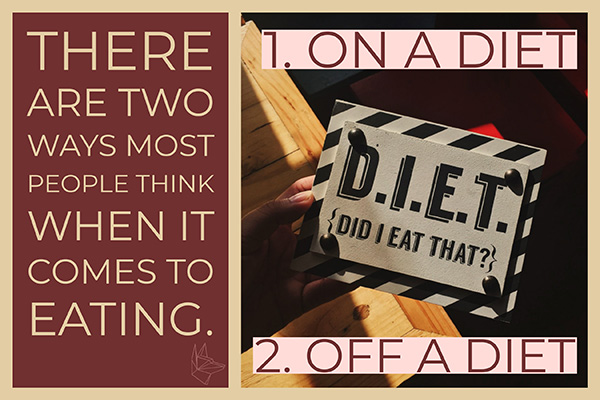
There are two ways most people think when it comes to eating.
1. On a diet
2. Off a diet
Being on a diet can mean various things and is usually related to the latest guru or eating fad. Being off a diet usually means that what you see is what you eat. Think about it, if everyone ate what they should off of their diet, eventually they should obtain their goal weight. Consider this in relation to your own habits. If you find you are not losing fat (or if you are gaining) over a period of time, you are not managing your diet break. It is likely you are not managing your diet at all.
When to Break
There is no hard and fast formula for when to break on a diet. General rule of thumb is 12 weeks after the starting point. This can vary depending on body fat levels, hormonal responsiveness, and psychological factors. For example, a man who has 28% body fat can ride out the whole 12 weeks in a deficit. A woman who has 19% body fat will likely have problems going that whole time; she would want to include cycling in her diet.
Diet breaks are not only relevant to body fat percentage. Several studies have shown differences in how fast the body regulates downward when a deficit begins. The point to remember is no matter what size you are, a complete diet break is needed.
How to Break
How you break is almost as powerful as how you diet. The break depends on the deficit and the person. You can simplify it and say, “Take a deficit break. Eat at maintenance for two weeks and then go back to dieting if needed.” This can work in theory, but often people need more direct instruction.
I am providing two break methods which vary enough to apply to a wide variety of dieters. Multiple methods can work, but I find the right ones make the difference. These can also be a jumping off point for your own design.
Fundamentals of a Break
There are a few fundamentals to keep in mind:
- Caloric intake needs to be at present maintenance level or slightly above. Current maintenance is what your caloric needs are at the time of diet break, not from the start of the diet. If you would like to learn more about this feel free to check out The Fat Loss Troubleshoot package.
- Caloric intake should not be excessive; it is not an excuse to be a glutton.
- Always assess the role training plays in your break and recovery.
- If you intend to diet down again after the break, do not try to make up for lost time by gaining fat back. Planning to lose it again does not make it okay.
- Expect to gain physical weight from food, water, and retention fluctuations. It can take one to two weeks to return to your pre-break weight.
Two Plans for Diet Breaks
1. Mo’ Food, No Problem
Who is it for?
This plan applies to people who don’t have a problem controlling their break. You understand that you need to refeed to offset the down regulation of your metabolic activity. You don’t have problems with binges and you stick to your dieting plan.
What should you do?
Days 1-14: Eat at your estimated daily caloric burn level. Reject carbohydrate phobia. Research estimates a need for carbohydrates in the range of 150 g (female) / 200 g (male) to start. Make sure to include starch based carbohydrates. This means if you are carbohydrate-phobic of anything that isn’t a vegetable, you may want to rethink your diet approach. Use the Bulking Cookbook for dieting break ideas to add starch-based carbohydrates to your diet.
While you should lightly monitor caloric intake, you don’t need extreme structure unless you notice an excessive increase in weight. It can sneak up on you easily. Refer to this article that discusses how much weight you should expect to gain in maintenance.
2. The Three Week Ease In
Who is it for?
This plan applies to people who have a problem controlling their break. This can happen for a variety of reasons ranging from emotions to post-dieting hypoglycemic reactions. As an aside, those who usually find themselves in this condition should strongly consider a cycle model diet/training program. Future programs I write will cover this.
What should you do?
First, you should extend your break for three weeks to include a seven day re-entry to maintenance.
Days 1-7: Increase your caloric intake by 10% of your current deficit every day (or until you hit assumed maintenance). If you were eating roughly 1,300 calories daily, you should increase it to 1,430 calories and so on.
1,300 x .10 = 130
1,300 + 130 = 1,430
This allows you to ease into eating higher calories and helps you to see how you feel as the calories increase. You might begin to feel intensely stuffed and uncomfortable when you reach the seventh day. This could be a sign that your intake is too high for your caloric need. If you feel this way several days in a row, it may be a sign you need to reduce your calories.
Lastly, while I don’t subscribe to popular multiple meal dogma, I do find increasing meal intake for this style of dieter helps with binging and carb hunger. If this is the case, try to increase your meal amounts to four to five per day. Also for larger men/women, you may find intake more comfortable this way. Personally, I eat fewer meals when dieting down and more in maintenance.
Days 8-22: Eat at your estimated daily caloric burn level. Reject carbohydrate phobia. Take in at least 150 g (female) /200 g (male) of carbohydrates to start. Make sure to include starch based carbohydrates. This means if you are carbohydrate-phobic of anything that isn’t a vegetable, you may want to rethink your diet approach.
Try and monitor your caloric intake and watch for signs of being too full day after day. A few times aren’t uncommon when coming out of a deficit; but if it’s happening repeatedly, it means you are gaining fat. Look for signs like extremely oily skin, excessive energy, back pains when sleeping, excessive bloating, and shortness of breath.
Closing
No matter which method you select, remember the break is as powerful as the diet. From a psychological and hormonal standpoint, dieting down can affect our bodies in numerous ways. And the only way to combat it is to rest and eat.
The next topic will cover the emotional side of diet breaks and how to view your goals in the right way.
—
1. “Role of adaptive thermogenesis in unsuccessful weight-loss intervention.” Angelo Tremblay, Geneviève Major, Éric Doucet, Paul Trayhurn. 2007.
2. “Clinical significance of adaptive thermogenesis.” Major GC, Doucet E, Trayhurn P, Astrup A, Tremblay A. 2007.
3. “Evidence for the existence of adaptive thermogenesis during weight loss.” Doucet, et al. 2001.
4. “Adaptive reduction in basal metabolic rate in response to food deprivation in humans: a role for feedback signals from fat stores.” Dulloo, Jaquet. 1998.
45 comments
lryda
January 21, 2010 at 6:03 amLeigh this is one of your best posts ever thank you! I was trying so hard to figure out what to do on a break. Without a plan I was eating everything in site.
I wanted to let you know this comment section do not work for me in IE8 unless I use the compability mode. Just to give you a heads up.
Leigh Peele
January 21, 2010 at 11:55 amThanks for the heads up. I don’t use IE and often forget to check out compatibility issues.
Stacey
January 21, 2010 at 8:03 amThanks for this post Leigh – I never realized that this was an okay thing to do! I find I need a break for my mind more than anything else! After this 12 week challenge, I will definitely be taking a planned break!
Leigh Peele
January 21, 2010 at 11:56 amA lot of people don’t realize it’s importance. Keep a look out for more discussion as to why.
cassondra
January 21, 2010 at 10:18 amThank you for your help in structuring this. This makes complete sense and should be easy to follow. YOU ROCK!
Leigh Peele
January 21, 2010 at 11:57 amVery welcome. There is always the simple method but I think some people feel more comfortable see something written out in detail.
Jenx
January 21, 2010 at 11:29 amLeigh what if you are doing a cheat day style program? Do you still need to take a break that long?
Leigh Peele
January 21, 2010 at 12:01 pmIf your diet is a weight loss plan (and weight loss is occurring) then you need to still break even if cycling and doing refeeds. Most cheat plans have a cheat day or a few days here or there and aren’t optimal as it is, let alone to be considered a break.
There is something to be said for a steady stream of caloric intake for maintenance.
Anna K
January 21, 2010 at 11:32 amAn excellent, very very helpful post. Thank you. Love the citations included, too.
Leigh Peele
January 21, 2010 at 12:02 pmThanks Anna.
Keith
January 21, 2010 at 11:40 amLove the matrix egg Leigh 😛
Cat
January 21, 2010 at 11:58 amthis is really helpful! I have never been successful at diet breaks…I am definitely going to try the three week plan after the challenge is up!
Leigh Peele
January 21, 2010 at 12:02 pmI don’t know it felt more like “Korn – Freak on a Leash” to me 😉
Janna
January 21, 2010 at 1:55 pmThanks Leigh – this post was something I’ve wanted to hear about for some time. I definitely did this wrong last summer and I overate with pre-diet estimate in mind – it was pretty upsetting and it scared me away from taking a break again until Christmas.
I like how you point out the importance of how feeling too full can mean you’re eating too much and this can lead to fat gain. May seem obvious to many people, but then again, the basic principles of fat loss are also “obvious” once the various guru hype is pushed aside.
What about training on a diet break? I know you say in FLTS not to use breaks as an excuse to go crazy (over train), but are there any other issues you can speak to?
Leigh Peele
January 25, 2010 at 8:47 pmSometimes dieting goes hand in hand with training. Meaning people start the programs at the same time. It is good to time a training break to work in conjunction with your diet break. What I like most is to take a deload the week before the break and then start back up during the high calories kick in.
Jordan
January 21, 2010 at 3:08 pmOkay, so cheat days aren’t enough. What about an “alternate day diet” strategy, where one goes into deficit one day, eats more the next day, repeat. Or a “window” strategy, where one goes into deficit for the part of the day, and eats more for a few hours. The periods of calorie deficit aren’t very long (one day or less,) so I’m wondering if there needs to be as much of a compensation.
Leigh Peele
January 25, 2010 at 8:49 pmOver time if you are losing weight at a noticeable rate you are going to need to break.
Jordan
January 28, 2010 at 2:18 pmAh, I see. It’s about the weight loss, not the calorie deficit. Gotcha. So, basically, if one loses weight, one will eventually run into problems no matter what. Well that sucks! lol. What a downer. Oh well. On the bright side, I have roughly 70 pounds to lose, and I’m male, so I doubt I’ll run into any problems for quite a while. That’s what I’m hoping for anyway….
Missy
January 21, 2010 at 9:55 pm“you begin to feel intensely stuffed and uncomfortable. This could be a sign intake is too high for caloric need”
OK, I have what may be a dumb question. Does feeling full/stuffed ALWAYS mean you have had too many calories, even if you are within your supposed calories for the day? For me, I have been doing the “OBM” for a while now – sort of IF, but not exactly. I don’t eat all day until about 4:30 or 5 and then I eat until about 9 or 10. I usually eat around 1500 to 1900 cals. So for me, I eat these calories within this short amount of time and this works for me because due to my hx of ED, I have no satiety index and eating lots of food but not going over my calories helps me “feel” full. But last night, I was pretty stuffed but was still allowed to have eaten more because I still had a “calorie savings” in my “calorie bank” for withdrawal :). So I did eat 2 oranges, but was really full. I just thought it was due to eating my days worth of food within the short time; but now, I am worried I shouldn’t be eating that much and it is too many calories. My weight has been basically maintaining, but I haven’t weighed in a week or more. Guess I need to do that :(. So my basic concern is that because I feel full (which is odd for me, the bottomless pit never feel full lady) I am now freaked b/c I have probably been overeating and am scared to get on scale.
*sigh*. This may have made zero sense. Not wise to type when tired and in freak out mode.
Leigh Peele
January 25, 2010 at 8:50 pmAre you talking about eating a full days worth of calories in one sitting, meaning one meal at once?
Missy
January 27, 2010 at 11:17 pmYes for the most part, I pretty much eat all my calories between 4:30 and 9 or 10, but I don’t eat it all at one meal. And I like being able to eat a lot at one time but I do feel really full and after I read what you wrote about feeling full/stuffed = too many calories, I became concerned.
Sally
January 22, 2010 at 1:12 pmLeigh,
Thanks for a great post.
I am a confused as to what you mean when you state, “Eat at of your estimated daily caloric burn”. This instruction in written in Plan #1 under Day 1-14, and in Plan #2 under Day 8-22.
Also, how do you determine maintenance calories while in a deficit that combines both diet and exercise? Perhaps I should look for this in my FLTS?
Thanks!
Leigh Peele
January 25, 2010 at 8:56 pmEvery day you burn a different amount of calories. Intake needs to be at a estimated amount of that assumed burn for that period of time. Maintenance in a deficit can decrease by varied amount for different people in different diets. A safe estimate can be 5-15%. It could also be you burn more calories when dieting down if it is the only time you put any effort to movement, which can be the case for some.
Activity , Exercise and the food you eat makes all of this up. Do the best you can to use your activity calculator and make adjustments based on your rate of loss. If still losing at a steady rate and increase seems to be going well you should be fine. Don’t over think to much. As always start low if nervous and increase as needed.
Brittany Reese
January 22, 2010 at 3:52 pmThis is so helpful! Thanks for giving us a bit more information on diet breaks. I know that they scare a lot of us, so it’s great of you to kind of hold our hands throughout the process.
I think I’m going to end up taking my diet break during the challenge before the 12 weeks is up. I know it will hurt my numbers for the challenge, but there’s this little thing in Austin called SXSW in March… And a music festival held in hundreds of bars is not a place to be in a deficit. 😉
Leigh Peele
January 25, 2010 at 8:57 pmHate I am not going myself when I vowed last year I would be going.
Brittany Reese
January 27, 2010 at 4:09 pmOh, Leigh. You have to do it one of these days. If not this year, do it next year for sure!
Beeb
January 22, 2010 at 11:27 pmI’m looking forward to the day I’ve been in a deficit long enough to need a break 🙂
Leigh Peele
January 25, 2010 at 8:57 pmNow that needs to be a quote for a lot of people 😉
Etana Finkler
January 22, 2010 at 11:54 pmLeigh,
Thanks for the great article.
I’ve done two 2-week diet breaks so far. I notice that the first week I am fine at eating between 1700-2000 cal daily. But by the second week the carbs have gotten a hold on me, as has the extra allowed meals, and I have a very hard time the second week. Do you have any suggestions for the affect of increased carb on my system? It’s the same on the weekend days of my carb-cycling, by Sunday I want more more more, but at least Monday comes and I jump right back on the 900cal high protein/vegie path…
So I’m okay about getting right back into the deficit. But I think I do damage that second week, both by extra calories, and also more processed carbs, more desires, unrest.
Also, I don’t know how “clean” the food needs to be; ie, eating more quantity and more bananas, sweet potatoes, and oatmeal is a lot different than eating Indian food, Chinese food, Italian food.. going to the restaurant. I look forward to this during the diet break or the carb-up day, but I wonder at the affect of the more processed foods of restaurants? Or is it only calories eaten vs calories burned, the deficit whatever I eat?
thanks, Etana
Leigh Peele
January 25, 2010 at 9:13 pmHow exactly do you feel when you refeed?
Etana Finkler
January 25, 2010 at 11:23 pmLeigh Peele says: How exactly do you feel when you refeed?
How I feel: second week: extra calories, more simple processed carbs like bread or pasta: more desires, unrest. addicted, craving, looking for love/I mean food, Or is it only calories eaten vs calories burned, the deficit whatever I eat? looking hunting wanting … look for something and end up in front of the fridge… I don’t feel this way with a protein meal.
Also, I don’t know how “clean” the food needs to be; ie, eating more quantity and more bananas, sweet potatoes, and oatmeal is a lot different than eating Indian food, Chinese food, Italian food.. going to the restaurant…. or is it just the amount of calories…not exceeding maintenance by more than 1-200 cal…?
thanks, Etana
Terry
January 24, 2010 at 8:24 pmThis sounds like a good approach to keep you in line.
Terry
Frak
March 14, 2010 at 2:15 pmHi Leigh.
After how long should someone consider taking a break? Should we wait for the weight loss to plateau – or would that be already too late? If weight loss has been going on nicely for 1 month and a half, should I consider taking a break soon just to “prevent”?
Thanks a lot for the article &, I hope ;), the answer!
ETANA FINKLER
June 25, 2010 at 1:56 amLeigh, where is the follow-up article to this:
You wrote:
“The next segment will discuss the emotional side of diet breaks and how to carry a correct view of your goals.”
thanks, Etana
Bulimia is a Bad Idea - 5 Reasons | Leigh Peele
July 1, 2010 at 1:12 am[…] do is to try to reintroduce food slowly back in the diet. In this article you can follow one model using the 3-week ease in. While there are more detailed models (like the one of wrote about in Metabolic Repair) this is a […]
No calories, no scale? | Leigh Peele
August 26, 2010 at 5:57 pm[…] a anxiety filled maniac, it’s time to eat until you don’t feel like that anymore. Do a proper diet break and then start all over expecting the same round of side effects you went through last time until […]
The Best of 2010 | Leigh Peele
December 28, 2010 at 10:05 pm[…] 10. Managing The Diet Break: The Plan […]
Underactive thyroid (hypothyroidism)? - Your Health & Wellbeing Forum
April 11, 2011 at 10:20 am[…] cheating at all and exercising often it could be your body needs a break. My favorite diet guru: https://www.leighpeele.com/diet-break-plan also: […]
Having an extended plateau = Planned diet break? - 3 Fat Chicks on a Diet Weight Loss Community Weight Loss Support
July 22, 2011 at 6:36 pm[…] Diet Break" http://www.bodyrecomposition.com/fat…iet-break.html "Diet Break Plan" https://www.leighpeele.com/diet-break-plan Thanks! […]
The Sexification of Rog Law: How I Determined My Fat Loss Calories & Macros
February 27, 2012 at 4:53 am[…] note that the bigger the deficit, the smarter you need to be about diet breaks and refeeds (check here for a great explanation as to what those are and why they’re […]
Kelly
April 12, 2012 at 9:00 amI need help! For the past three years or so I have been eating at roughly 1000 calories, and lost some weight at first. But surprise surprise, it stopped working after so long. I then tried a variety of horrible ideas. Low carb for a few weeks (under 20g), carb cycling (50g for two days, 20g for a day, 150g for a day and so on), weight watchers, and various other “crash” diets. Now, I know this was horrible and I’m convinced I have screwed over my metabolism. I’ve recently been reading up on increasing calories to maintenance (I’m an avid myfitnesspal-er), and I have been eating approx 14-1500 calories for the past three weeks. My TDEE is 1994 and my BMR is 1449. I’m 22, 5’3″ and maybe 140-145 lbs? I don’t own a scale… The past three weeks I’ve been on a diet break and I know I’m gaining rapidly because my clothes are getting tighter. Also, I just got my period yesterday which I havent had in months…maybe years, which I contributed to stress/birth control/whatever. (TMI?) Anyways, is eating 1400-1500 calories enough to count as a “diet break?” And how much longer should I keep eating like this/not exercising? It’s very difficult mentally to be eating more and not exercising while gaining weight. To be honest I’m still eating fairly low carb (50-100g/day) because I’m terrified of carbs, probably because I am misinformed and doing light exercise (Jillian Michaels videos, 30 minutes of circuits a few times a week). I would love to read your e-books, but cannot find any links online to purchase both of them. I would GREATLY appreciate your feedback, HELP!
Time for an experiment - 3 Fat Chicks on a Diet Weight Loss Community Featherweights
July 3, 2012 at 6:36 pm[…] http://www.bodyrecomposition.com/fat…iet-break.html And also found this Leigh Peele link useful: https://www.leighpeele.com/diet-break-plan __________________ My story so far: One year down, 40+ pounds lost, almost […]
5 Tips to Get You Off a Plateau | Half Size Me
January 28, 2014 at 11:00 pm[…] https://www.leighpeele.com/diet-break-plan […]
Your GPS for a Weight Loss Plateau: Five Alternate Routes | Half Size Me
February 18, 2014 at 11:00 pm[…] Peele’s article, Managing The Diet Break, will guide you through the appropriate break method for you. It answers the fundamental break […]
Chris Hall
October 30, 2016 at 12:00 amHi Leigh, I’ve got a question on short refeeds vs longer refeeds and and/or.
I’m operating on a 500kcal/day deficit with 1 refeed day a week. It’s done wonders for my training intensity carb loading like that. I’ve read that a lot of the horomones don’t really recover from short breaks though.
Would it be wise to work in a longer refeed period every 8-12 weeks. Should I have a longer period in a 6/1 pattern? maybe 4 months before a longer break? Suggestions?